The 5 lies you're being told about AI in travel
I've been hearing the same lines about AI in travel for over a year now, repeated by consultants, LinkedIn gurus and salespeople with little knowledge of the industry. Here are the 5 that do the most damage, no filter.

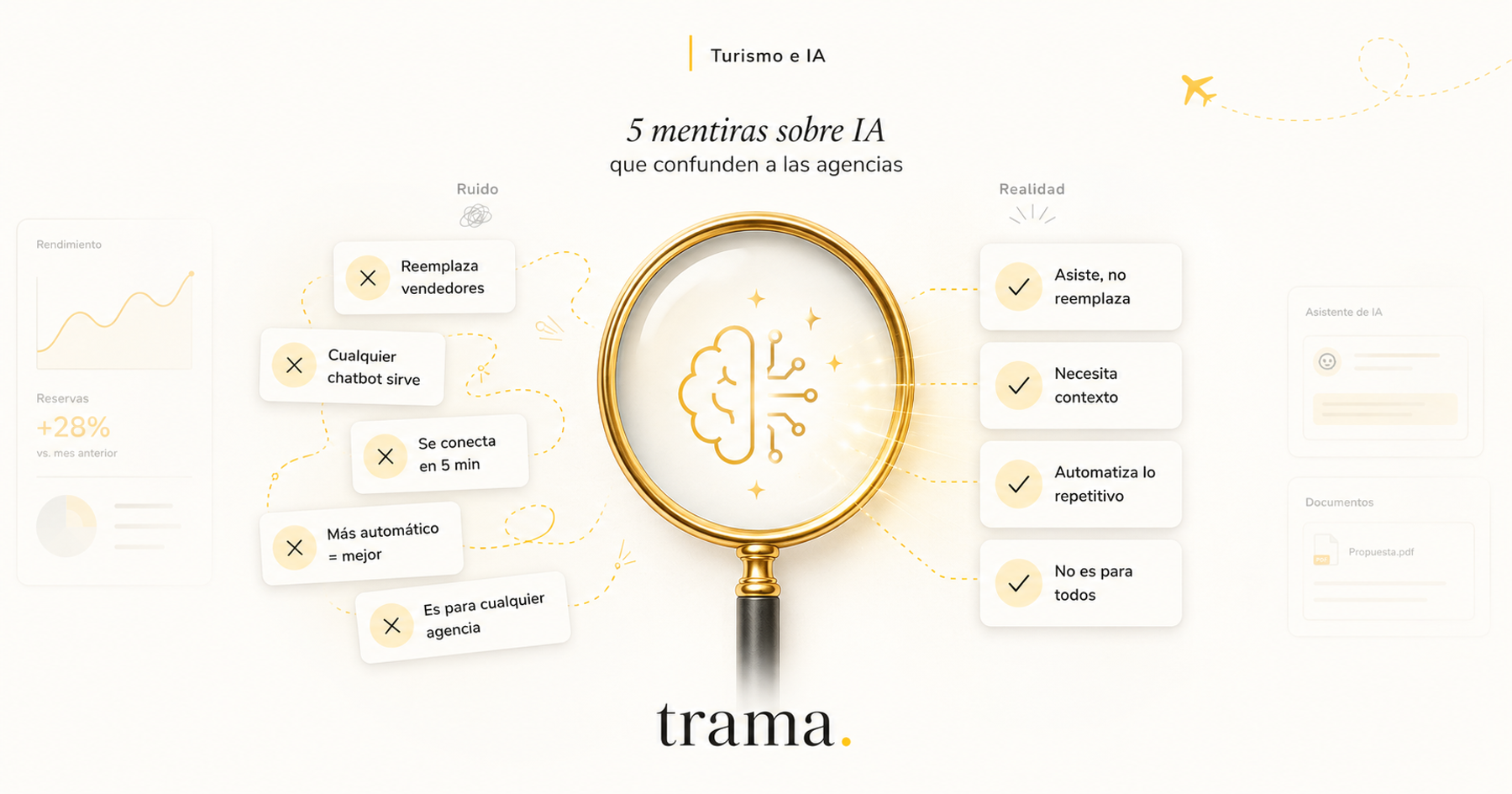
For over a year now I've been talking every day with owners of travel agencies about the same topic: how to bring AI into their operation. And there's something that keeps coming up in every conversation.
The industry is flooded with statements that sound good but are false. Consultants repeat them, LinkedIn gurus repeat them, some salespeople with little knowledge of the field repeat them. And agency owners, who have a hundred things on their mind, don't have time to verify.
So here's what I see from the inside. Five statements you hear all the time about AI in travel, and why they're false. No filter.
Lie 1: AI is going to replace your salespeople
This is the most repeated and the most harmful. The ones selling AI tell it to scare you, and the ones who hate it tell it to defend the status quo.
Let's get concrete. A client messages your WhatsApp on a Wednesday at 11:40 PM asking about a trip to Cancun. A well-built AI responds instantly, asks the key questions, offers two or three reasonable options, and leaves the conversation ready. So far, the AI did well what a human would have done badly because they were sleeping.
But the moment of closing, when the client is about to pay 4,000 dollars for their honeymoon, that moment remains human. Always. People don't hand that kind of money to a machine without first talking to someone. There are studies showing that 83% of people who use chatbots want to be able to talk to a human without having to repeat everything.
Your salesperson isn't competing with the AI. Your salesperson is competing with other salespeople. The AI takes the robot work off their plate, hands them the warm lead with all the context, and frees up their time and energy to do what only they can do: close the sale.
If someone sells you AI by telling you that you'll be able to fire half your team, they're lying or they don't understand how a trip is sold.
Lie 2: Any chatbot solves the problem
This one is told by companies with a generic product who want to convince you that your agency is just another case. It isn't.
There's a strong data point that's been bouncing around enterprise AI research for months: between 70% and 85% of AI projects fail. The technology doesn't fail. Implementation fails when the product is generic and the company that bought it has no time to configure it.
A chatbot that answers frequently asked questions about your website has nothing to do with an assistant that qualifies WhatsApp leads, understands which destinations you handle, knows how to tell a honeymoon trip from a family trip, and routes the lead to the right salesperson. The first is a support tool. The second is a conversational operating system.
When someone offers you a chatbot for your agency, ask: does it know the difference between an outbound and an inbound destination? does it understand seasonality? does it have context about the catalog you actually sell? does it know that in March you don't send Brazilian tourists to Bariloche because the season is over? If the answer is no, it's not built for travel. It's a telco chatbot dressed up with a travel skin.
Lie 3: We'll connect it in five minutes
This one comes from people who sell software with a generic SaaS mindset. They don't say it in travel because it's true. They say it because that's what SaaS says about itself.
The truth is more boring. An AI that actually operates your agency needs to know how you work. How you respond. What information you ask for first. Which fares you use, which wholesalers, how your quoting process works, when a human salesperson steps in, when automatic follow-up kicks in. None of that is set up in five minutes. It's built with you over a week, maybe two.
The most honest thing an AI vendor in travel can tell you is: "give me a week to understand your operation, then I'll start configuring". If they tell you "connect WhatsApp and you're done", what you're going to have is a bot that responds generically, confuses your clients, and that you'll switch off in two weeks.
The speed of implementation is not a quality indicator. It's a shallowness indicator.
Lie 4: The more automatic, the better
This one is among the most dangerous because it sounds logical. If the AI can do everything on its own, that's better, right? No.
In travel, especially in the outbound segment with medium and high ticket sizes, the client buys trust. They buy a person who knows the destination, who has been there, who has contacts on the ground, who will fix it if something goes wrong. That's very hard to convey through AI, and honestly, today I don't even want the AI to try. The AI's job is to filter, qualify, organize, save time. Closing the sale and managing the relationship are human work.
There's a subtler version of this lie: "the AI learns on its own, no need to review it". That's only true if you don't care about quality. An AI in production needs review, adjustments, new examples. It's not something you turn on and forget. It's another teammate. You train it, correct it, improve it over time.
The goal isn't for AI to do everything. The goal is for AI to do the repetitive work well, so you can focus on what matters.
Lie 5: AI is for every agency
This is told by the people selling, not the people implementing. And it's going to sound strange coming from me, because I sell AI. But the truth is that not every agency is ready for this.
If fewer than 50 inquiries come into your agency every month, you don't need AI. You need to sell more. AI solves a scale problem: many conversations, little time, invisible losses. If your problem is the number of inquiries coming in, what you have to fix is your ad spend, not your operation.
If there are no basic processes in your agency, AI isn't going to invent them. If you respond to each inquiry differently, with no criteria, without knowing what data you want to capture, the AI will inherit that chaos amplified. The rule is brutal: a bad operation with AI is a bad operation, faster.
The agencies that get the most out of AI are the ones that already have some process in place, enough volume for the investment to pay off, and a real pain that keeps them up at night. If that's not your case, save the money and the frustration. Come back when you're ready.
What is actually true
Let me close on the positive side, because there are things that are true and worth highlighting.
It's true that AI changes the equation for agencies that receive many inquiries through WhatsApp. Responding instantly, 24 hours a day, with the right tone, was impossible three years ago. Today it's viable. And that alone, for an agency losing 70% of its inquiries because of slow response times, is already a brutal shift.
It's true that AI, when implemented well, gives your salespeople time back. Time to advise, to research destinations, to maintain relationships with clients who have already traveled. Time to sell better, not just more.
It's true that the travel industry is behind on adoption. While real estate and healthcare already have AI adoption rates of 28% and 10% respectively, travel sits around 16%. There's a window for those who move first. But a real window, not the marketing one.
And it's true that this isn't going to stop. The question isn't whether AI will be in your agency, but when, how, and whether you bring it in yourself or the market shoves it in when it's already too late.
One last thing
If you've made it this far and you're evaluating AI for your agency, the best advice I can give you is not to hire us. It's this:
Talk to three different vendors. Ask them the uncomfortable questions. Ask for real cases from the travel industry. Ask to speak with their clients. If any of the three promises you something that sounds like one of the lies above, drop them without guilt.
AI in travel is real, and it's changing the rules. But like any revolution, it comes with a lot of noise. The hard part is separating what's true from the marketing.
If after filtering out that noise you want to talk, you know where to find us.

Yaco Peralta
Co-founder & CEO, trama.
Construyendo trama. para que las agencias de viajes vuelvan a tener foco en la asesoría humana.
More posts by Yaco Peralta