You've got a Río promo ready to sell. You want a short video for your stories and Instagram. You ask someone to design it, you wait four days, and you pay extra for it. Or you never make it, and you end up selling the trip with just text and two photos.
This week that changed. You make that video yourself, in ten minutes, without waiting on anyone.
What always cost time or money
There's a part of the job that isn't selling but eats your hours all the same, no matter who does it: you, your community manager, or the agency that runs your social. Putting together a proposal that looks professional. The video for the promo. The graphic for the feed. The clean itinerary the client reads, understands, and gets sold on. All of it has to be produced, and producing it well takes time.
That takes time or costs money. Almost always both. A nice proposal is two hours of a salesperson. An edited video is a designer and several days. And since nobody has that time, the usual thing happens: the proposal goes out rushed in an ugly PDF, the video never gets made, and on social you end up forwarding the flyer the operator sent you.
It's not laziness. Since making something of your own always cost time or money, forwarding the operator's flyer as-is is the easy path. The problem is that the agency next door does exactly the same thing, with the same flyer, the same promo. You open Instagram and every promo for the same destination looks identical. Nobody stands out.
Why that changed now
Until recently, doing this with AI was a mess. One tool for video, another for images, another for writing. Almost all in English, almost all paid, and none built for someone who isn't from the tech world.
This week, at its biggest event of the year, Google showed several new things and put them inside the same app you already have on your phone. And here's the important part: creating images or video with AI was already possible a while ago. What's new is what they showed now, which brings almost everything into one place and makes it faster and easier to use for someone who isn't technical.
Five things you can do this month, without overcomplicating it
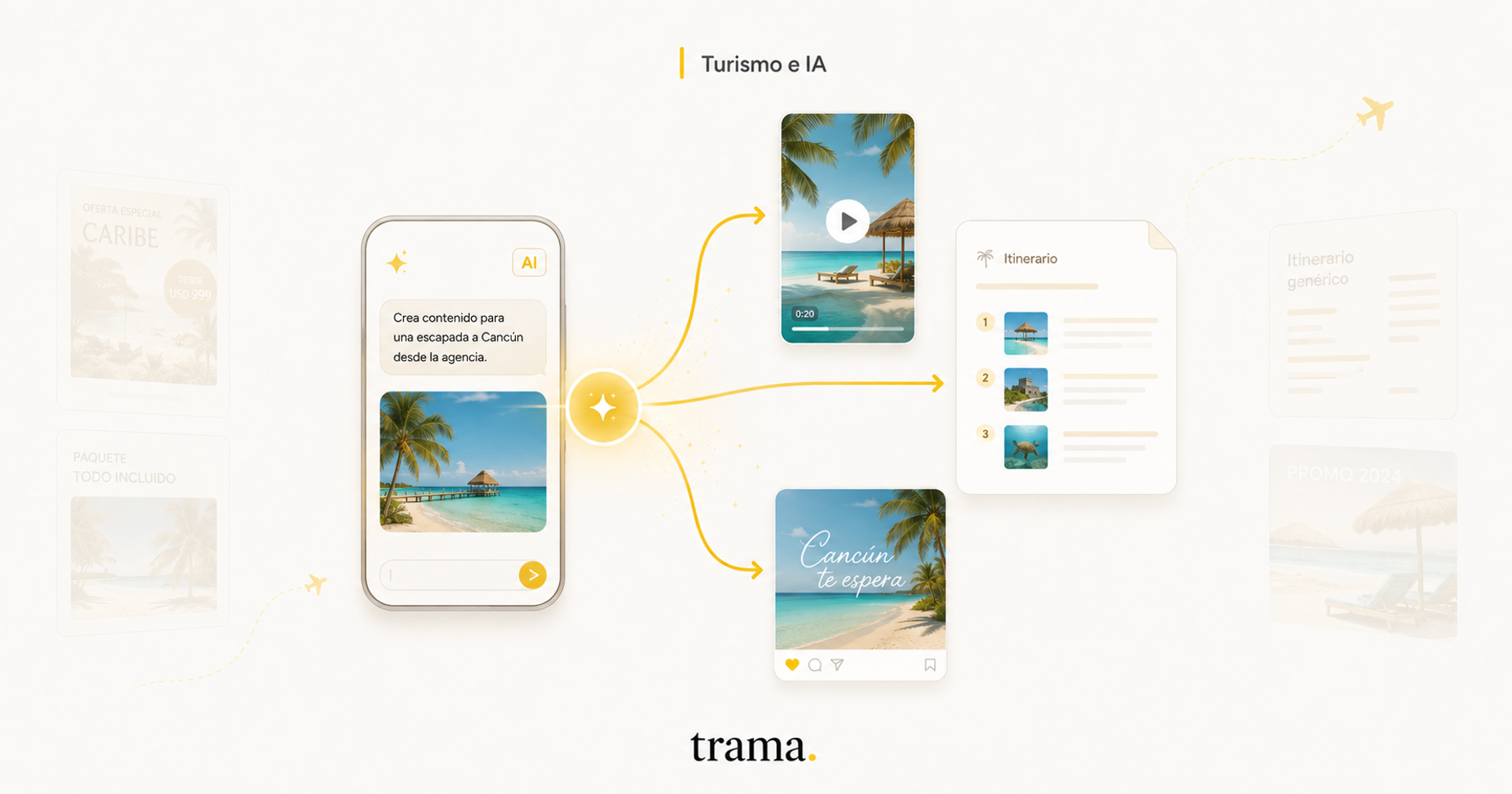
Short video for a promo. The new thing this week is called Gemini Omni. Before, to make a video with AI you had to go to a separate tool. Now, from the same Gemini app, you give it a photo of the destination or the hotel, you write what you want to show, and it builds you a clip of about ten seconds for a story or a reel. If something's off, you tell it and it changes it, like talking to an editor. It works for a weekend promo or for a more inspirational video of the trip, with your own stamp and what you want to say, instead of the same material everyone shares. A straight word on cost: Omni's video isn't in the free plan, it comes with Gemini's paid tiers. The cheapest is Google AI Plus, which runs between 5 and 8 dollars a month depending on the country, and in several markets in the region it sits closer to 5 than to 8. That cheapest plan already gets you Omni video plus the image and text features, so for what most agencies need there's no need to jump to the 20-dollar Pro plan.
An honest note, because it matters to know the limits. The clips are short, they carry a mark that flags them as AI-made, and you still need judgment so they don't come out generic. They don't replace real production for a big campaign. But for the day-to-day of your stories, they're more than enough.
Images and graphics. Here the new thing has a name: Google Pics, for creating and editing images, on Google's latest engine (you'll see it called Nano Banana). The most useful part for you: you take the flyer the operator sends you, the one half the city shares identically, and you redo it with your own stamp, your logo, and your message. Or you ask it, by text or voice, to build the promo graphic from scratch. You stop looking like every other agency. A note on this: for images it's neck and neck with ChatGPT's image creator, which is also very good. There's no clear winner. ChatGPT tends to do better with fine detail and text inside the image, Google is faster. Try the same graphic in both and keep the one that works for you.
Proposals and itineraries from your own data. This is the one that helps an agency most. There's a Google tool called NotebookLM, where you upload your own files: the operator's PDFs, the terms, the destination info, your rate sheets. You ask it questions and it works only with what you uploaded, it doesn't go looking elsewhere. That sharply lowers the risk of it inventing a price or a condition, which is exactly the fear of anyone who's tried AI for this.
With that it can build you the day-by-day itinerary, prepare a presentation ready to send the client (you download it as PowerPoint or PDF), and even make an audio summary of the trip, like a podcast explaining the plan. All from the documents you already have loaded in the folder.
Text, replies, and content. The same Gemini app, now with a new engine they launched this week, faster and smarter than the previous one (you'll see it as Gemini 3.5 Flash). It writes you ideas for social in your tone, rewrites a proposal so it reads better, or builds you a full content calendar. Stop fighting the blank page.
What these tools don't do. All of this helps you produce: video, images, proposals, text. None of them answers the inquiries coming in on WhatsApp while you're building the video. That attention, sorting the inquiries and not losing any, is a different job. It's the part we handle at trama. Creating content, on the other hand, is much more within reach today with what came out this week.
What it costs to keep going as you were
Let's use round numbers. If a salesperson builds five proposals a week and each takes two hours, that's ten hours a week. Getting the rates and cross-checking what each supplier sends you is still manual, heavy work, and neither Google nor we fix that for now. But once you have the data together, turning it into a clean proposal, an itinerary, and a presentation is where the other hours go. That part does shrink to minutes.
A promo video ordered from outside costs you money and several days of back-and-forth. Multiply that by every package you want to push in the month. The math doesn't favor keeping on doing it the old way.
None of this asks you to hire anyone or install a new system. It asks you for half an hour on a Tuesday to try it with a single package. If you're still paying for a video you now make yourself in ten minutes, you've already got your first task for the week.

Yaco Peralta
Co-founder & CEO, trama.
Construyendo trama. para que las agencias de viajes vuelvan a tener foco en la asesoría humana.
More posts by Yaco Peralta