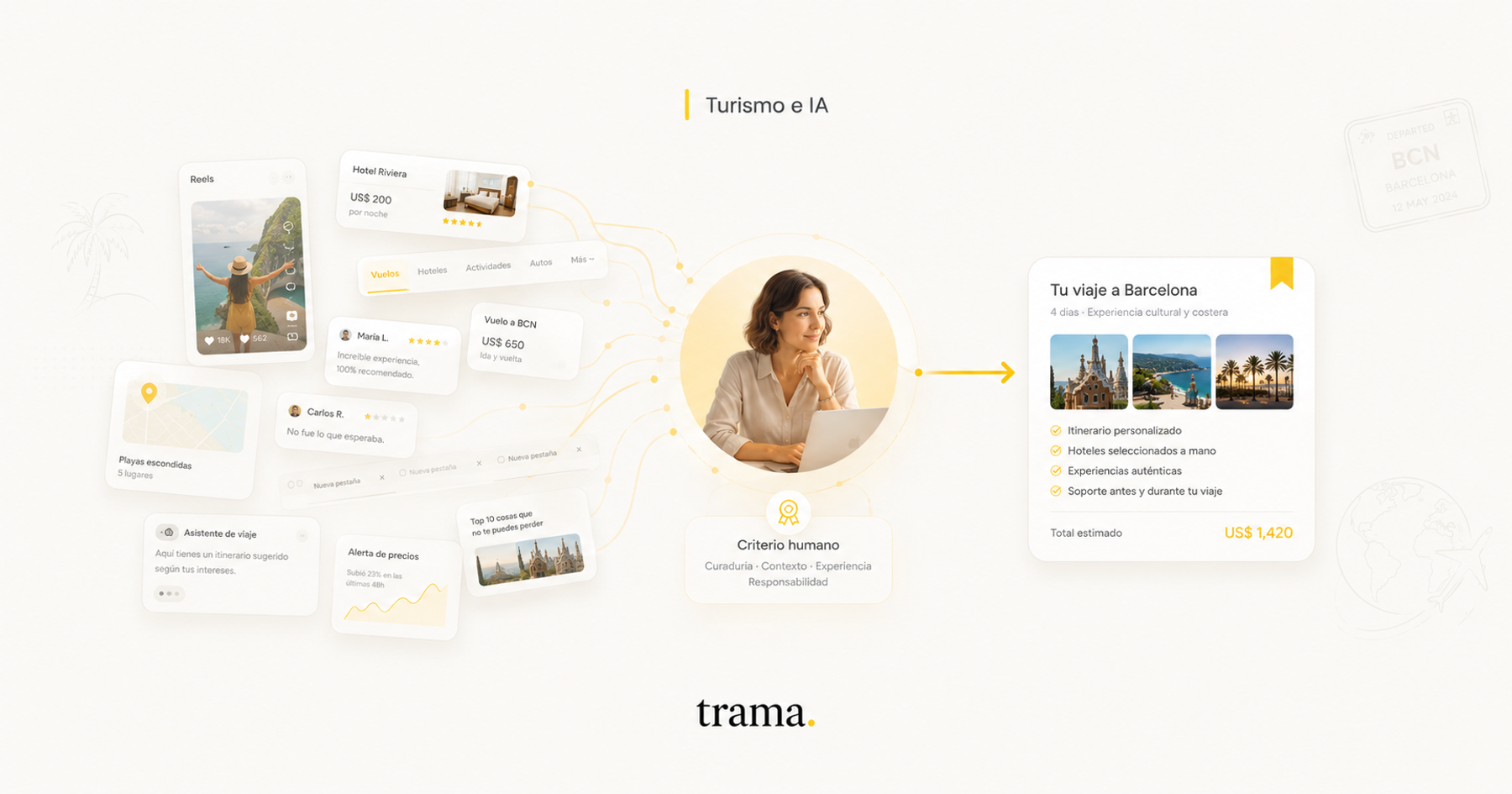
The client messaging you today has already watched forty reels of the destination, compared prices across three open tabs, and asked a chatbot what to do with five days in Thailand. They arrive knowing more than ever. And more lost than ever.
Not long ago, clients came to your agency precisely because you had what they couldn't get on their own. The fares, the destinations, the contacts, the information that lived inside a closed world. You were the door into that world.
That world opened up. Today anyone walks in. The information that used to make you indispensable is now everywhere, and it's free. The client believes they no longer need you for that, and they're right. For that, they don't need you anymore.
The strange part is what happens next. The more information they have, the harder it is to decide. They've got forty possible hotels, eighty reviews that contradict each other, and an itinerary built by a machine that never set foot in the place. They're paralyzed. And right there, exactly then, they message you. The problem is that many agencies answer as if the client knew nothing: they send the brochure, throw out three options from the catalog, confirm yes, we have that package. They hand more information to someone already drowning in it. And then they wonder why the client asks for a quote and disappears.
The value moved
For decades the travel agent's business was access. Access to the fares, to the systems, to what the ordinary traveler couldn't reach on their own. You were the gatekeeper of a closed place. Today the doors are open and there's no gatekeeper who gets paid to let people through.
What didn't open up, what's still scarce, is judgment. Knowing which of the forty options is the right one for this particular person. Knowing that the hotel with a 9.2 rating is far from everything. Knowing it rains on those dates. Knowing the client says they want adventure but really wants comfort with a good adventure photo. That isn't on Google. It's in your head, after years of sending people to those places.
And there's something more, which is what truly makes you worth paying for. When the trip goes wrong, and sometimes it does, there has to be a name and a phone number that takes responsibility. Not a form. Not a chat that walks you in circles. A person. The traveler who spends serious money pays for that. They don't pay for the information, they already have it. They pay for having someone to call at eleven at night when their flight gets canceled.
And this isn't just a hunch of mine. Industry data shows that the travel adviser business, far from shrinking, has been growing, by close to 17% in recent years. The client who looks for one keeps getting older and wealthier. They're not chasing the lowest price. They've grown tired of arranging everything themselves and would rather pay someone who solves it well.
Where to put your time now
Change the first reply. When an inquiry comes in, stop sending the brochure. Ask a question that shows judgment: is this your first time there or do you already know the area? Do you like to move around a lot or stay in one place? Someone drowning in options feels relief when somebody asks the right question instead of piling on more options.
Put your name and your face in the middle. The traveler who already researched on their own doesn't want to talk to the agency. They want to know who the person taking responsibility is. The agencies winning this game have salespeople with names, who sign off on what they build and are on the other end when needed. A client can point to that person and say she organized my trip. You don't compete on price with that.
Free up the time that makes you worth paying for. Here's the trap. If your value now is judgment and response, every hour you spend copying data from a chat into a spreadsheet, building the same quote for the tenth time, or replying yes, I'll send you info at two in the morning, is an hour you're not spending where the client actually pays. The part that sets you apart is the human one. But your day disappears into the robot part.
That's what led us to build Trama: so the robot work (answering the same inquiries over and over, tracking what was sent to each client, putting together the report on how the week is going) doesn't eat the time that should go to advising and closing. It isn't the only way to get there. You can add people, build templates, organize yourself better by hand. The principle doesn't change with the tool: your judgment time is the most expensive thing you have. Don't spend it on tasks that don't require judgment.
The cost of standing still
Let's do the math. An agency with 300 inquiries a month that keeps answering like it did ten years ago, with a brochure, a delay, and generic options, converts around 1%: three sales. The same agency, answering fast and with judgment, letting the salesperson spend their time closing instead of managing, reaches 3% without forcing anything. That's nine sales. At a ticket of 1,500 dollars, the difference between one and the other is nine thousand dollars a month. Not from working more. From working where the value is.
And that's only the money you can see. The money you can't see is the client who would have spent triple and never even messaged you, because another adviser answered first and answered better.
Travelers have never had this much information at hand. And they've never been this willing to pay someone who helps them not drown in it. Your job didn't disappear. It moved. The only question that matters is whether you moved with it, or whether you're still standing where the value was ten years ago.

Yaco Peralta
Co-founder & CEO, trama.
Construyendo trama. para que las agencias de viajes vuelvan a tener foco en la asesoría humana.
More posts by Yaco Peralta