A simple question to start.
If I ask you, right now, how many inquiries came into your agency last month over WhatsApp, and how many of those ended in a closed sale, could you answer?
Most of the travel agency owners we talk to can't. Not even close to the number. And it's not that they don't want to. It's because the system they operate on, WhatsApp, wasn't designed to measure a sales process.
This post is about that. About the number almost no agency measures. About why it's worth measuring even though it stings. And about how to do it next week without installing anything.
The number that hurts
Let's go to the data.
An MIT study published in Harvard Business Review analyzed over 15,000 sales inquiries and found something brutal: companies that respond in under 5 minutes are 100 times more likely to qualify the lead than those that take 30 minutes. Not 10 times. A hundred.
Another data point from the same study: 78% of customers buy from the first company that responds. Not the cheapest. Not the best. The first one. And the industry average response time, across all sectors, is 42 hours.
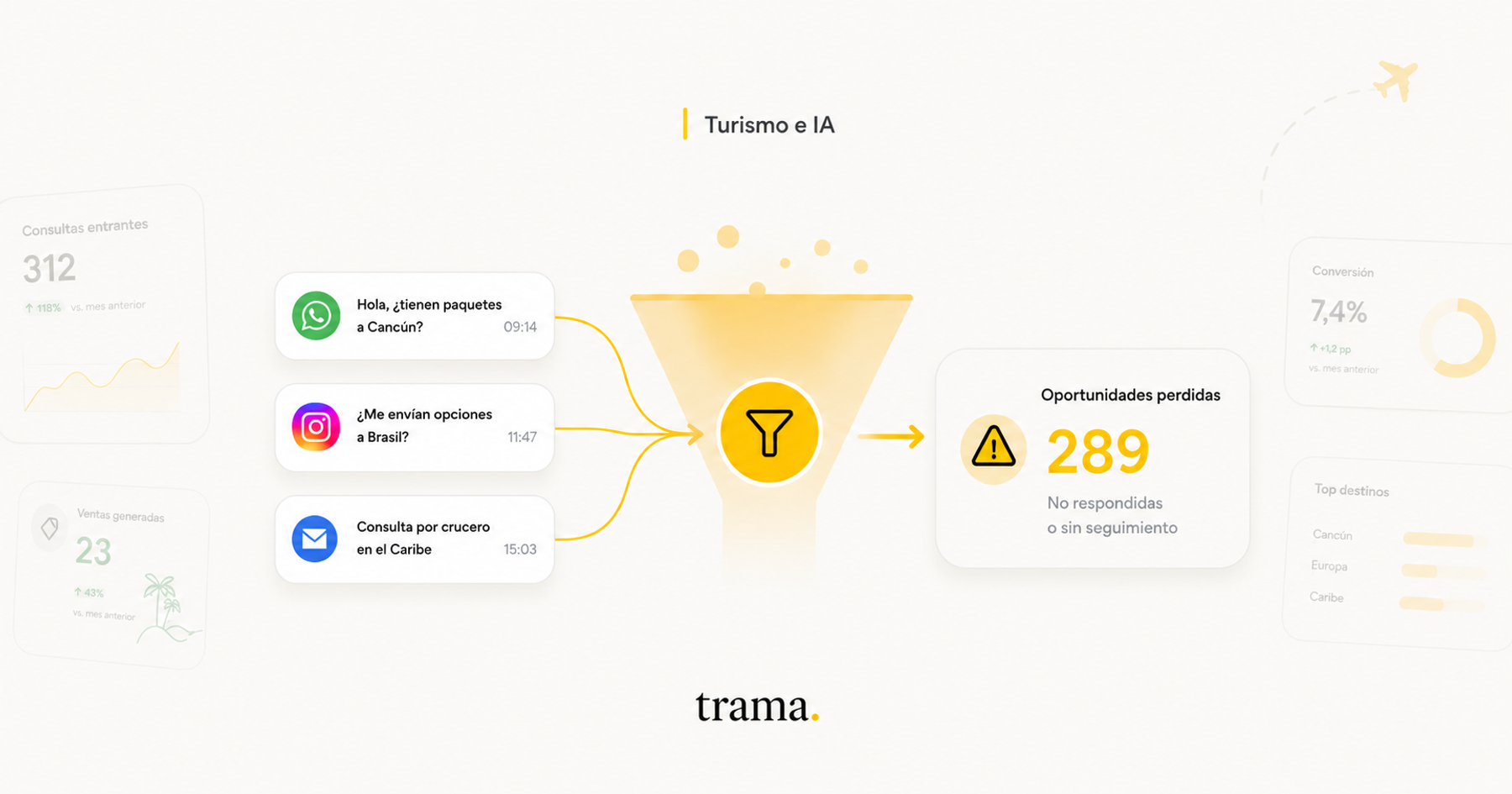
Think about this in your business. Someone is searching for a trip to Punta Cana on Instagram. They click on an ad. They message you on WhatsApp at 11:47 PM. Your team sees it the next day at 9 AM. By that time, they've already messaged three other agencies. One of them answered at 11:51 PM with a friendly greeting and two questions. That one is going to close the sale. You're going to be option number three or four, fighting over a discount.
Multiply that by all the inquiries that come in outside business hours, on weekends, on Tuesday at 3 PM when you were having lunch, on Friday at 7 PM when you were already closed. The math gets ugly.
In one agency we saw up close, with 200 inquiries per month and a 1% conversion rate, 198 people left without anyone knowing why. Some weren't real. Others were and never came back.
Why your agency isn't measuring this
The short answer is that measuring it, today, is very uncomfortable. The long answer has three layers.
WhatsApp is a black hole by design
WhatsApp Business isn't a CRM. It's a messaging app. Conversations live on the salesperson's phone. When that salesperson leaves, the conversations leave with them. If you have five salespeople, you have five phones, five separate inboxes, five different criteria for how to respond.
There's no single place where you can see, at a glance, how many inquiries came in, how many were answered in under 10 minutes, how many had no follow-up. The data exists. It's on the phones. But it's fragmented, and nobody looks at it.
Traditional CRMs don't work for small agencies
The natural thing would be to say: install a CRM and you're done. The problem is that CRMs were designed for long sales cycles, B2B, with manual data entry the salesperson does at the end of the day. In a travel agency with salespeople handling 30 simultaneous WhatsApp conversations, that's science fiction.
Almost no small or mid-sized agency in Latin America uses a CRM seriously. They try. They drop it in a week. They go back to WhatsApp. The friction of loading data manually while the customer waits on the other side of the chat is unsustainable.
Urgent beats important
The inquiry that came in two minutes ago weighs more than the inquiry that came in two days ago and never got a response. Always. The team works on the conversation that's open now, not the one that went cold. With that, lost inquiries become invisible. And if nobody counts them, they don't exist.
What you're losing (and it's not just money)
When an agency starts measuring this, three types of costs appear.
The first is the direct money. If your average ticket is 2,000 dollars and you let ten real inquiries slip every month, that's 20,000 dollars of potential revenue lost. Even if only 30% of those would have closed, that's 6,000 dollars a month. Seventy-two thousand a year. For a small agency, that's the difference between growing and stagnating.
The second is the opportunity cost of your ad spend. If you invest in Meta Ads, you're paying for those clicks to reach you. Every inquiry that comes in and isn't answered fast is money you threw at the ads. And worse: you're financing that person eventually buying from the competitor who did respond on time.
The third is the most expensive long-term: the cost of not having commercial intelligence. Without knowing which inquiries you lose, you don't know which destinations people are asking for and you're not covering. You don't know which type of trip you're not quoting well. You don't know if the problem is response speed, price, or the offer itself. You're operating blind, deciding based on memory and gut feeling. And memory lies.
How to measure this next week without installing anything
You don't need a system. You need an hour of focused work, a spreadsheet, and the decision to look at the number even though it stings.
This is the minimum viable version. You can do it next week.
1. Define what counts as an inquiry
An inquiry is any person who contacted you asking for information about a trip in the last month. It doesn't matter if it was good or bad. If they messaged asking for info, it counts. This is important: many agencies mentally filter out the inquiries that weren't real before counting them, and that distorts the number. Count everything.
2. Count the total universe
Block out an hour on a Saturday morning. Open every team WhatsApp. Count how many new conversations started in the last calendar month. Don't re-read them. Just count.
You'll get a number. Write it down. That's your universe.
3. Count the ones that closed in a sale
Cross that universe with your booking system or the spreadsheet where you track sales. How many of those conversations ended in a confirmed sale in the same period. That's your real conversion rate. The one you've never measured.
4. Subtract
Total universe minus confirmed sales. That's the number of inquiries that came in and didn't buy. Of that group, some weren't real, some weren't ready yet, and some went and bought from someone else because you didn't respond on time or didn't respond well.
5. Look at the number for a week
You don't have to understand everything on day one. The important thing is to see the number, let it breathe for a week, and start asking yourself what percentage of that is recoverable.
If your conversion is 1%, it's not because people don't buy. It's because your sales process lets 99% of them slip. Moving that number from 1 to 2 already doubles your business without spending an extra dollar on ads.
What happens after you measure it
I've seen three typical reactions when an agency owner sees this number for the first time.
The first is anger. Anger at the team, at the ads, at the market. It's unfair but it's human. Lasts a couple of days.
The second is realizing the problem isn't the team. It's the system. Good salespeople doing their best with the wrong tool will get this result every time. The fault isn't with the people, it's with the process.
The third is the useful one: starting to act on the data. Deciding that inquiries coming in outside business hours have to get at least an automated acknowledgement. Deciding that no lead who said "I'm interested" can go more than 48 hours without follow-up. Deciding that on days when the team is overwhelmed, speed wins over detail.
None of these decisions is revolutionary. But none of them is possible if you don't measure.
Why AI changes the equation here
What changed in the last 18 months is that you no longer have to choose between speed and quality of response. A well-built conversational assistant can respond to a travel inquiry at 11:51 PM with the right tone, ask the customer the questions your best salesperson would ask, qualify whether it's real, and leave the conversation ready for a human to close the next day.
It's not magic. It's a shift in layers. The repetitive layer (responding, qualifying, organizing, following up) is done by a machine. The layer that actually matters (advising, negotiating, closing, building relationships) is done by your team, now with the time and context to do it well.
That's exactly what we built at Trama: travel-specialized assistants that live inside the agency's WhatsApp, so the customer never changes channels and the team doesn't load anything. But, honestly, the point of this post isn't to sell Trama. It's to get you to measure the number first. If after measuring you decide it's worth solving, there are several ways to do it. Ours is one of them.
One last thing
If you made it this far, do it. Don't read another post about AI in travel, don't hire anyone, don't install anything yet. Sit down this Saturday, count the inquiries from the last month, count the sales, subtract. That number is going to change the internal conversation in your agency.
And if afterwards you want to see what it looks like when all of that is measured automatically, write to us. We've already solved that part.

Yaco Peralta
Co-founder & CEO, trama.
Construyendo trama. para que las agencias de viajes vuelvan a tener foco en la asesoría humana.
More posts by Yaco Peralta