Almost no agency has a sales problem. It has a process problem. That difference isn't a detail: one gets fixed by hiring better salespeople, the other doesn't get fixed by anyone.
An inquiry comes in over WhatsApp on a Saturday afternoon. Before it turns into a closed sale or a lost one, it goes through six stages. In almost every agency, each of those stages relies on someone remembering. And memory isn't a process.
The six stages where the money leaks
Follow an inquiry through its whole journey and you'll see where it gets lost.
One. The inquiry comes in. If nobody answers in time, the traveler is already talking to another agency. If someone answers but dumps the entire quote at once, the traveler takes the info and buys on their own. The first reply sets up everything else.
Two. Qualifying. Not every inquiry is worth the same. There are the ones with dates, a budget, and a decision, and there are the ones just asking around. When nobody qualifies, your salesperson spends the same energy on both, and the good ones wait.
Three. Handing it to the salesperson. The traveler already said who they are, how many are traveling, and where to. If that information doesn't travel with the inquiry, the salesperson starts over asking the same things. The traveler gets tired. You can tell when an agency has no memory.
Four. Contact and the quote. This is where the real human work begins: understanding the case, building the proposal, setting the price. It's the stage where the salesperson brings what no machine can. The problem is almost never here.
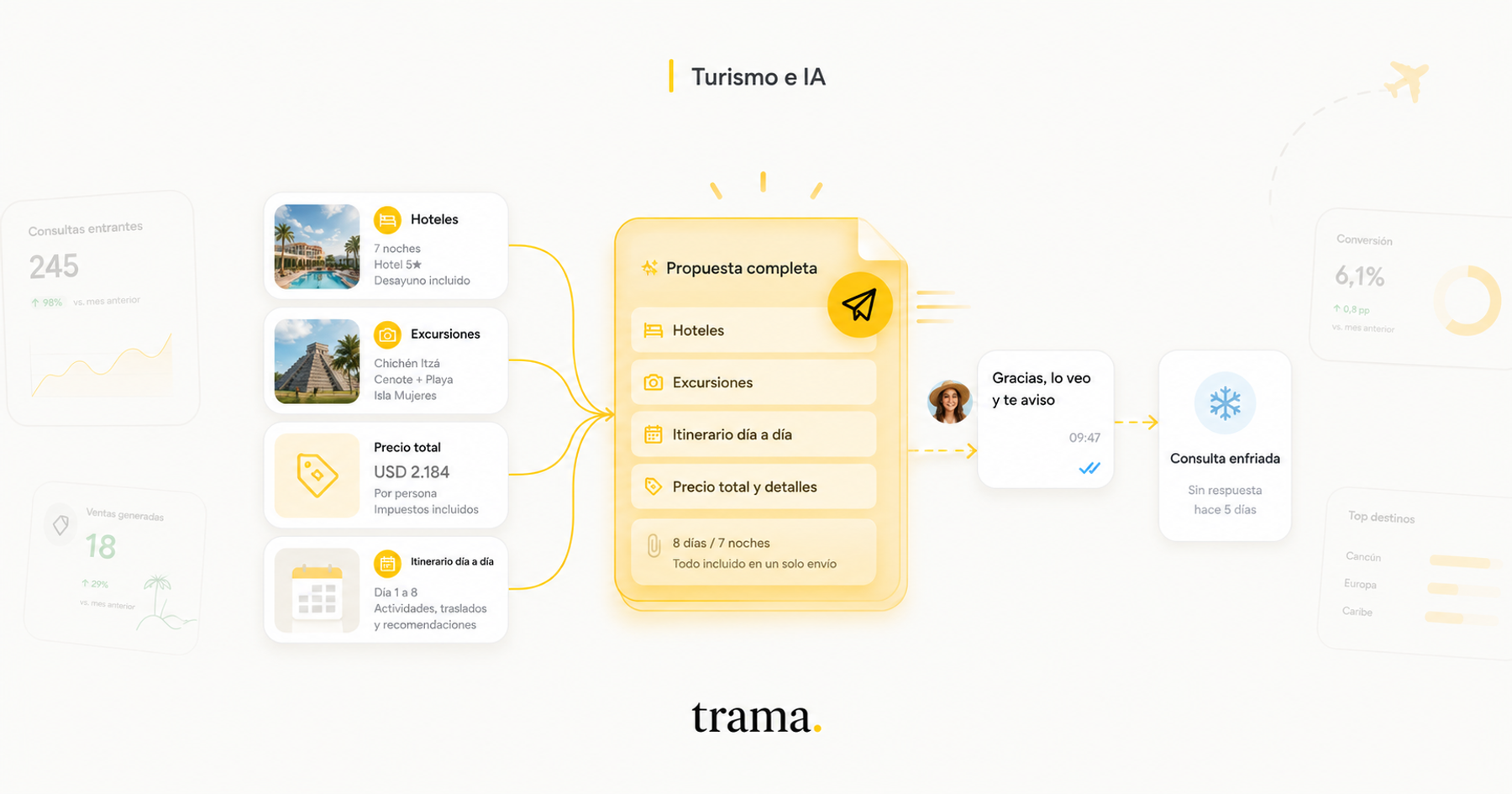
Five. The follow-up. This is where most of it falls apart. Sales almost never close on the first message. They need two, three, sometimes five follow-ups. But the salesperson sends the quote, the client says 'I'll look at it and get back to you,' and nobody writes again. The quote goes cold on its own.
Six. Closing and recording it. Won or lost. Why? If the reason isn't written down, you lose the one thing that would make next month better. The agency knows what it sold. It almost never knows what slipped away or why.
Why the process doesn't exist
This isn't your team working badly. It's that the process doesn't live anywhere. It lives in each salesperson's head, in personal chats, in a spreadsheet one person fills out when they remember. Nobody owns each stage. When everything depends on each person's willingness and memory, the day volume spikes, the process is the first thing to break.
And WhatsApp, which is where all of this happens, doesn't help. It's perfect for talking and terrible for keeping a record. What was said on Tuesday is nowhere to be found on Friday. Every inquiry starts from zero.
What a process that actually works looks like
A process that works doesn't need anyone to remember anything. Each stage has a clear owner and gets recorded on its own. The inquiry gets answered and qualified right away. The opportunity reaches the salesperson with full context, ready to work. Follow-ups get remembered. The close gets logged with the reason. It doesn't depend on the kind of day anyone had.
That's what Trama does, and it's why we built it as a sales assistant, not as one more tool to fill in by hand. It answers every inquiry, advising conversationally, captures all the data, qualifies the client, and hands the salesperson a real sales opportunity with the full context already put together. From there the work is the salesperson's: make contact, quote, decide. Trama goes along for that part: it reminds them of pending follow-ups, saves every quote they sent, and records the close, won or lost, with the reason. It doesn't quote for them or close for them. That's still human. What it does is make sure no stage depends on someone remembering.
It doesn't have to be Trama. What can't be missing is for the process to exist outside your team's heads. A disciplined spreadsheet and the habit of reviewing it every day cover part of it. What doesn't work, and I see it all the time, is still trusting that everyone remembers on their own.
When everything gets recorded, you stop guessing
And there's an even bigger payoff. When every inquiry, every quote, and every close gets recorded, you stop having a pile of loose chats and start having information about your own business. Which destination people ask for most and which one doesn't sell. How long you take to reply and whether that delay is costing you sales. Which salesperson needs a hand and which one is closing well. Why you lose the ones you lose. That's what turns the operation into decisions: where to put your ad spend, which promotion to run this month, who to add to the team. You stop running the agency on intuition and start running it on what the numbers show. Almost every agency has that data going by every single day. The problem is that it evaporates in the chat the moment the conversation ends.
What it costs to leave it as is
Run the numbers on your own agency. If two hundred inquiries come in a month and you close 1%, that's two sales. If you tidy up the process and move to 2%, that's four. At a ticket of fifteen hundred dollars, that difference is three thousand dollars a month. You're not selling twice as much or working twice as hard. You're just no longer losing what was already coming in the door.
The most expensive part is the part you can't see. The lost sale doesn't show up anywhere. It shows up as a 'thanks, I'll look at it and let you know' that never came back. And the next month, it happens again.
Run the simplest test there is. Take the last ten inquiries that came in and follow each one through the six stages. See where they fell. If you can't even reconstruct the journey, that's already the answer, and also the first task.

Yaco Peralta
Co-founder & CEO, trama.
Construyendo trama. para que las agencias de viajes vuelvan a tener foco en la asesoría humana.
More posts by Yaco Peralta