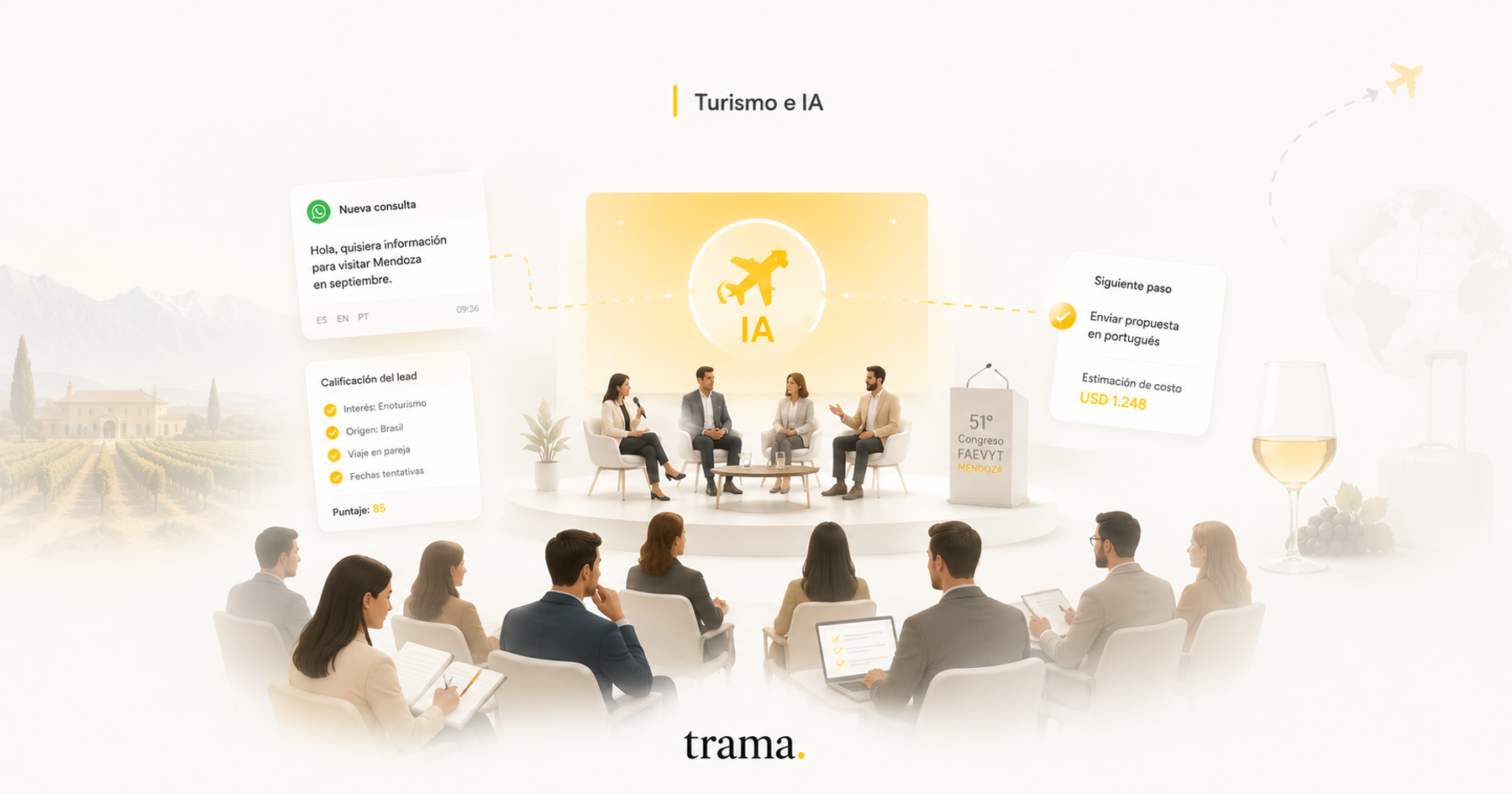
Twenty-one hundred travel agents in Mendoza, two days, auditoriums full from the first talk. The 51st FAEVYT Congress was the largest in its history. And if I had to pick one word that came up in every panel, every hallway and every dinner over wine, it would be artificial intelligence.
We went to present trama. and came back with quite a bit more than that. Two days listening to agency owners, operators, inbound specialists and providers from all over the country left us with a pretty clear picture of where the industry stands. Here is what we saw.
AI went from promise to agenda item
A year ago, at the Gualeguaychú congress, I was already hearing people talk about artificial intelligence. But it felt far away, a talk you went to out of curiosity. Agencies didn't yet see it as a need of their own, it was more a topic for the future than for Monday morning. In Mendoza that changed completely. The talks on AI applied to tourism had the fullest rooms, and not out of curiosity. People took notes, asked about prices, asked how you actually implement it.
The title of one of the talks sums it up: from chat to check-in. That is exactly the field tourism plays on today. Everything starts in a conversation and ends in an experience, and AI has started to step into the middle of that chain. Not to replace the person who sells, but to take off their plate the part that keeps them from selling.
The interesting shift was the tone. Nobody was asking anymore whether AI is useful. They were asking which one, for which part of the business, and how much it costs to start. When a technology moves from whether to how, it is because it stopped being a fad and became a management decision.
The fear changed shape
For years the travel agent's fear was that the internet would erase them. That the client would build everything alone and the agency would become redundant. It didn't happen. Something else did: the client arrives with more information than ever and more lost than ever, and ends up needing someone to sort through the noise.
The same thing is happening with AI. The fear that a machine will sell trips instead of the agent runs into a reality from inside the business: the trip closes between people. Nobody puts down three thousand dollars for a honeymoon because a bot was charming. They put it down because on the other side there was someone who understood what they wanted and took responsibility for it.
What does change is where the day goes. Whoever keeps spending their hours copying data, answering the same thing two hundred times and chasing old quotes is spending their most expensive time on the cheapest part of the job. That was the real conversation at the congress, even if it wasn't always said in those words.
Mendoza put wine tourism on the table
The host city was no accident. There were workshops dedicated to food-and-wine tourism and to inbound tourism, and there you could see something that in other cities is sometimes less obvious. Wineries, wine tourism operators and high-mountain providers have a problem the average outbound agency does not: they serve travelers from half the world, in several languages, with experience catalogs far more complex than a package to Cancún.
We talked to wine tourism operators with huge catalogs, where each winery has three kinds of visit, different languages, different capacity limits. To wineries only now figuring out how to open the door to the international traveler without building an entire customer service department. And to high-mountain providers, like Outdoor Mendoza, who run trekking and expeditions for people arriving from all over the world and needing an answer in their own language, not the agency's.
For that kind of operation, an immediate first response, in the traveler's language, that understands the catalog and routes to the right human when there is a real lead, is not a luxury. It is the difference between capturing the tourist who wrote at two in the morning from the other side of the world, or losing them because you replied the next day when they had already booked elsewhere.
What people took away, and what's worth doing now
Separate generic AI from AI that understands your business. One thing is an assistant that answers anything with a couple of instructions. Another is something that understands how a package is quoted, how a lead is followed up, how you serve a traveler who was already here last year. The first is a toy. The second moves the needle. Before paying for anything, that is the question worth asking.
Start with the bottleneck, not the flashy part. Most agencies don't lose money for lack of marketing. They lose it because inquiries come in through WhatsApp and get answered late, or not at all. Before thinking about anything sophisticated, look at how many of last month's inquiries turned into a sale. If you don't know the number, that is the first hole.
Try small before changing everything. You don't have to flip your whole operation overnight. Take a single process, the one that hurts most, and solve it well. With trama. we always start there: the first response and qualifying the inquiry, which is where the sale most often falls through. It is not the only way to do it, but the principle holds with any tool: one process truly solved is worth more than ten half-done.
What we really took home
We presented trama. at the Maipú Tourism Chamber, which brings together more than a hundred and eighty providers, and the feeling was the same the whole time: there is an entire industry trying to understand AI seriously, not as a buzzword but as a concrete tool to sell better and live a little calmer. That was the most valuable part. Not the technology. The number of people already ready to use it well.
What we took home from Mendoza is that the industry stopped asking whether AI will enter tourism. It already did. The question now is a finer one: it is not about adding tools for the sake of adding them, or jumping on AI because it is in fashion. It is about adding AI that truly understands how tourism works, how a package is quoted, how a traveler is followed up, how you serve the one who was already here last year. That is the difference between spending money and solving a problem. And from what we saw at the congress, more and more people in the industry already know how to tell one from the other.

Yaco Peralta
Co-founder & CEO, trama.
Construyendo trama. para que las agencias de viajes vuelvan a tener foco en la asesoría humana.
More posts by Yaco Peralta