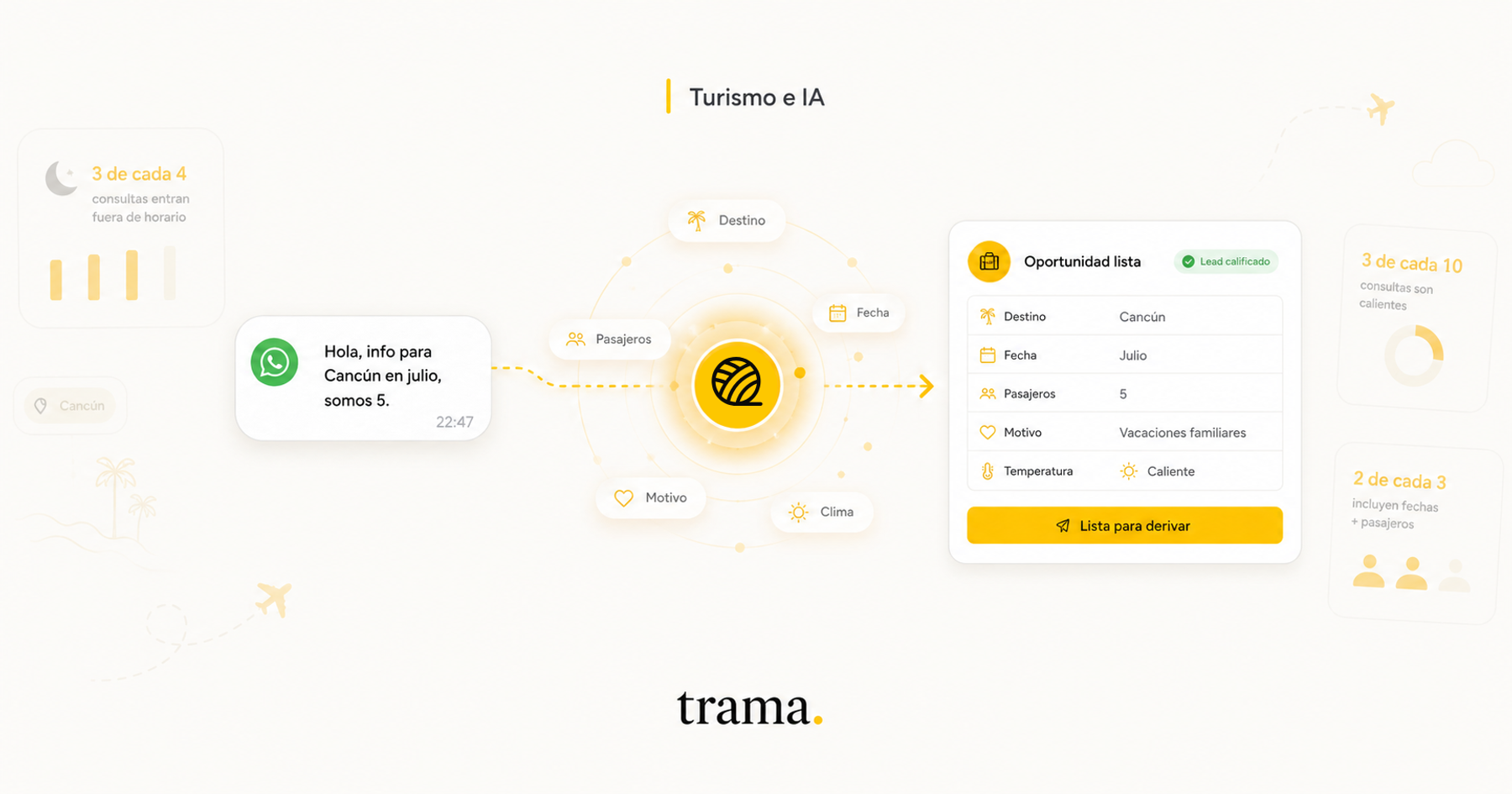
It's 11:40 on a Saturday night. A WhatsApp comes in: "Hi, info for Cancún in July, there are 5 of us." At most agencies, that message waits until Monday. By then, the person has already messaged three other agencies.
At the agencies using trama., by 11:41 there's already an open conversation. And on Monday the salesperson doesn't find a loose message: they find a qualified opportunity, with destination, dates, number of travelers and even the reason for the trip.
We've spent a few months with trama. handling the WhatsApp of real agencies. We pulled the numbers from that real operation. This is what an agency using it gains.
It works when you can't
The figure that surprised us most has nothing to do with speed. It has to do with timing.
3 out of 4 opportunities are born outside business hours. At night, in the early morning, on weekends. Exactly when the agency is closed and the inquiry, historically, fell through.
That's not "responding fast". Any bot replies at three in the morning, that impresses no one anymore. What changes is that trama. doesn't just reply: it interviews, builds the brief and leaves the opportunity qualified while the agency sleeps. The work a salesperson would do on Monday morning is already done by the time they open up.
It separates what matters from the noise
An agency's WhatsApp is a funnel full of noise. Window-shoppers who'll never buy, wrong numbers, "do you take installments?", people asking for something you don't sell. The salesperson's boring job is to dig through all of it to find the one who'll actually travel.
trama. does that job. It reads every inquiry, sorts it by temperature (hot, warm, cold) and builds the salesperson's queue by priority. Of everything that comes in, it separates what's ready to close (close to 3 out of 10 arrive hot) from what needs work and from what's plain noise.
And it doesn't pad the queue to look useful. Whatever doesn't meet the minimum standard you define, it holds back instead of passing it on. The salesperson doesn't open the app to find fifty half-finished conversations. They find, first, what's ready to close.
The salesperson stops filtering garbage. They go straight to what moves the needle.
It doesn't hand you a chat. It hands you a ready opportunity.
Here, for us, is the real differentiator.
A WhatsApp inquiry is an orderly mess. "Hi, there are 4 of us, something beachy in January, not too expensive." trama. doesn't forward it raw to the salesperson. It talks, asks what's missing and turns it into a brief.
Pulling the destination from a message is something anyone can do. trama. goes further: in 2 out of 3 inquiries it also extracts the dates and the number of travelers, and in nearly 1 out of 3 it captures something almost no system understands: the reason for the trip. A honeymoon, an anniversary, the family holidays. The detail that changes how the proposal is built and how it closes.
To get there, it sustains the conversation. There were inquiries of up to 22 back-and-forths handled entirely by the agent, asking exactly the questions a good salesperson would. The inquiry isn't just filtered: it's improved. The salesperson opens a hot opportunity with context, not a nameless "hi".
It learns your catalog and remembers your travelers
You hand it your flyers and PDFs, and trama. builds the catalog on its own. In these months it read and loaded more than 50 products without anyone typing them in by hand. Our favorite case: a one-person agency, with 33 products loaded by the AI. A solo operation working with the structure of a much bigger one.
And it remembers. More than 400 traveler details saved across separate conversations. The client who wrote again after months doesn't have to start from scratch: trama. already knows who they are, where they traveled and what they like.
What this proves
It's not a chatbot firing off loose answers. It's not a system where someone has to load data by hand to look at it later. It's your agency's operation happening inside the conversation, which is where it already happens anyway. It attends, filters, prioritizes, enriches and hands off. Without you changing anything about how you work today.
Where this is going
These months were about organizing one side of the business: sales. What comes next is closing the loop with the other side: marketing.
Think about how it works today at almost any agency. On one side there's the ad spend: money going out every month to bring in inquiries, with no clear way to know which campaign brought travelers and which brought window-shoppers. On the other side there's sales: the team handling whatever arrives. Two worlds that don't talk to each other. The marketing budget dilutes because no one can connect the ad with the sale that did, or didn't, close.
trama. already has the missing piece to join them: the data. It saw every inquiry come in, knew which one warmed up, which one fell through and why. With that, the same AI that organizes sales today starts to optimize the ad spend. Which campaign brings real travelers, who to show what to, where the budget is being wasted. Marketing and sales stop being two separate spreadsheets and start feeding each other: what closes tells the ads what to do, and the ads bring in more of what closes.
That's not an aspiration. It's what gets unlocked when a single system has all the data of the operation. Decisions on numbers, not on gut feeling, and a funnel that sharpens itself, month after month. Every inquiry that comes in leaves trama. a little sharper for the next one.
There's a piece we're finishing: getting the close of the sale registered inside the system. Today that lives outside, between the salesperson and the client, and we're not going to make it up. But it's exactly the piece that completes the loop, and it's the first thing we're on. When it's there, the cycle closes end to end: from the ad to the close, all measured, all connected.
And from there, deeper: wholesalers and inbound operators with complex catalogs, more channels beyond WhatsApp, agents connected to the industry's real systems. A whole agency, marketing and sales, running on one system that learns from everything that happens.
The part that doesn't change is the one we care about most. trama. takes care of everything your team shouldn't be doing, so your team can do the one thing a machine can't: sit down with a traveler, understand what trip they're dreaming of, and close it.
Deals get closed between humans. trama. takes care of the rest.

Yaco Peralta
Co-founder & CEO, trama.
Construyendo trama. para que las agencias de viajes vuelvan a tener foco en la asesoría humana.
More posts by Yaco Peralta