Free CRM for travel agencies: what's actually free
The CRM is free forever, with no contact or user ceiling. What we do charge for is having the AI do the logging itself.

Free plan and pricing checked against Trama's billing code (@trama/billing, @trama/crm) on 2026-08-14.
There's a scene that repeats in almost every agency we work with.
Someone opens a Google Sheet on Monday. It has columns named "Client", "Destination", "Status" and "Follow-up", and the last three rows were filled in eleven days ago. Next to it, five phones running WhatsApp Business, each with its own inbox, its own judgment calls, and its own conversations nobody else can see. And somewhere in the middle, an inquiry about Punta Cana that came in on a Saturday at 11:47 p.m. and never got answered, because by Monday there were forty more on top of it.
The natural conclusion is "we need a CRM". And that's where the real problem starts, and it isn't the price: it's that almost everything you find when you search for one was built for a different business, and almost everything you find when you also search for free was built to stop being free.
This post is about that. What a CRM has to do to survive its first month inside a travel agency. Why the word "free" in this industry usually hides an expiry date. And what's free in Trama, item by item, including where the limit is and what costs money. Here's the whole idea in two sentences, so you don't have to read the rest unless you want to.
Most agencies run their CRM by hand: someone logs the client, someone logs the opportunity, someone writes down the follow-up. If that's how you're going to work, and there's nothing wrong with working that way, don't pay for it. In Trama all of that is free, with no expiry date, no contact ceiling and no user ceiling. What we charge for is something else: having the AI do the logging itself, straight out of the conversation with the client, without anyone typing. So you can see what that means, the free plan includes the agent answering on your site and on your microsite, with no cap on opportunities.
Which means the question here isn't "how much does a CRM cost?", because the CRM is free and it will stay that way. The question is a different one: "what is the work worth, of someone attending, asking and organizing every inquiry that comes in?". That difference isn't about price, it's about category. We don't sell a CRM: we give it away, because a CRM is a filing cabinet and a filing cabinet shouldn't cost you money. What we charge for is an AI employee and the work it does, and you pay it the way you pay someone who works: for what it produces, not for how many people on your team open the system.
And that work isn't just replying. It's asking and qualifying, logging the opportunity with destination, dates and passengers, assigning it to a rep, recording the follow-up and writing again when the conversation goes cold. And on top of all that, reading what happened and telling you.
A CRM gives you somewhere to write things down. An AI employee does the writing down, and then reads it back to you.
Let me put it up front so there are no surprises: Trama is our product. But the first half of this post is still useful to you if you end up picking a different tool, or none at all.
One last number before we start. An MIT study published in Harvard Business Review looked at more than 15,000 sales inquiries and found that companies responding in under 5 minutes are a hundred times more likely to qualify the lead than those taking 30. A hundred, not ten. And 78% of customers buy from the first company that replies: not the cheapest, not the best, the first.
That's what's actually at stake when we talk about "getting organized". It isn't tidiness. It's that the inquiry that came in on Saturday night goes to whoever answered on Saturday night.
What a CRM has to do in a travel agency (and what it shouldn't)
The CRMs you know, the big ones, the ones that come up first, were designed for a very different business than yours. Enterprise sales, three-to-nine-month cycles, one rep handling twenty accounts, and an hour at the end of the day to log what happened. In that world, typing data in by hand makes sense: there are few deals and each one is worth a lot.
A travel agency is the opposite. One rep can have thirty conversations open at once, each in a different state, and most of them close or die within 72 hours. Asking that person to open another tab and fill in a form while the client is typing on the other side isn't demanding, it's impossible. Which is exactly why almost no small or mid-sized agency in Latin America runs a CRM seriously. They try, they drop it within a week, and they go back to WhatsApp and the spreadsheet.
So before looking at prices, it's worth defining what one would have to do to survive month one.
Turn an inquiry into a record without anyone typing
This is the first thing, and the thing almost no generic CRM does. When someone writes "hi, info on Cancún in January for 2 adults", there is already a destination, an approximate date and a passenger count in that sentence. If it doesn't get captured automatically, it will never get captured at all. The record has to come out of the conversation, not out of your team's discipline.
Give it an owner with a name
An inquiry with no owner is an inquiry that falls through. It happens constantly on a shared WhatsApp: three people saw it, nobody picked it up, everyone assumed someone else had. The system has to say who has it and since when, and it has to say that without anyone remembering to assign it.
Show states that tell the truth
"Following up" means nothing if someone set it nine days ago and never moved it. The state has to reflect real work: answered or not, quoted or not, client replied or not. If the state depends on someone's willingness to update a field, within two weeks every state in your pipeline will be lying at the same time.
Keep the client's history
Travel is a repeat-and-referral business. The person who went to Brazil in January will ask about the Caribbean in September, and will send you their brother-in-law. If your team starts from zero when they write back "have you traveled with us before?", you've thrown away one of the biggest advantages you have over an OTA.
And what it shouldn't do
It shouldn't be a booking engine. It shouldn't replace your tour operator or your accounting system. It shouldn't ship with two hundred customizable fields that somebody will spend three weeks configuring and nobody will ever fill in. A CRM that tries to be all of your agency's software ends up being the software nobody opens.
Why "free" is almost never free
Search for a free CRM for travel agencies and you'll find roughly four things. None of them are a scam; all of them have a cost that isn't in the headline.
Model 1: the trial that expires
This is the most transparent of the four, because at least it puts the date up front. Clientify, for instance, gives you "14 days to try everything". Capsule also uses 14 days for its paid plans. Others give 30.
Kommo, formerly amoCRM, is one of the names you'll hear most in the industry, and it's worth knowing this before you invest time in it: it has no free plan. It has 14 days with no card, and after that you pay or you lose access.
The problem isn't the number of days, it's what you do while they run. You're going to spend those fourteen days importing your clients, building your pipeline, and convincing your team to actually use it. In other words, you're going to invest the most expensive part of the project right before you have to decide whether to pay. And on day fifteen the question is no longer "is this tool right for me?" but "am I going to throw away two weeks of my whole team's work?". That isn't a free trial: it's a down payment.
Model 2: freemium with a contact ceiling
This is where the heavyweights live, and credit where it's due: some of these free plans genuinely don't expire. HubSpot's free CRM says so explicitly, "unlike a free trial, it's 100% free with no expiration date", and includes up to 1,000 contacts. Capsule offers a free plan "for travel agencies and agents with up to 250 contacts".
It sounds generous until you run it against your own numbers. An agency taking 60 inquiries a month hits 250 contacts in a little over four months. And the ceiling counts accumulated contacts, not active ones: the guy who asked about Bariloche once in March and never replied again also takes up a slot. The free plan fills itself up with people who will never buy from you, while your business simply operates normally.
The second cost of this model is subtler. In the big freemium products, what's free is the contact filing cabinet; what you pay for is everything that makes a CRM actually work: the automation, the workflows, decent reporting, the integration with the channel you actually sell on. You get the cabinet for free and the engine separately.
Model 3: the user ceiling
The user ceiling is the one that does the most damage inside an agency, and it almost never gets discussed. Back to HubSpot's free plan, which alongside those 1,000 contacts includes two users. Hold that against your team: if you have five salespeople, the free plan covers two. The same thing happens, in paid form, with any CRM that charges per user.
Kommo is the clearest example here, because it charges per user: its cheapest plan starts at US$15 a month for every person you add. It isn't expensive per user; the problem is what it pushes you to do. Every rep you add makes the tool cost more, so the decision to have your whole team inside stops being obvious.
And there the right decision, put all five inside, so everything lives in one place, is also the expensive decision. What almost every agency does is the predictable thing: they give access to the two who "sell the most", and the other three stay on their personal WhatsApp. The CRM is incomplete from day one, the numbers it shows are fiction, and four months later somebody concludes that "the CRM didn't work".
The pricing model pushed you into using it wrong. Later it will feel like the tool's fault.
Model 4: the empty CRM
This one has nothing to do with money. A generic CRM doesn't know what a destination is, or a check-in date, or a passenger, or high season. It knows about "companies", "contacts" and "deals".
So somebody on your team (usually you) is going to spend three weeks creating custom fields so the tool understands your business, and half of those fields will sit empty because they have to be filled in by hand. Starting from scratch is a real cost even when the license says zero.
Six questions to ask any CRM before you sign
This is the part of the post that's useful to you even if you don't pick Trama: the six questions I'd ask, in this order, in any demo. Ask them of us too; Trama's answers are further down, and some of them aren't what you'd want to hear.
What exactly happens the day my free plan or trial runs out? Not "what plans are there", but what happens to what I already loaded. Does the whole account lock? Do I lose read access? Do the data stay for a month, a year, or get deleted? This question separates the ones with a real free plan from the ones with a trial in disguise, very quickly.
Does the price depend on how many people use it? If the answer is yes, do the math with your entire team, not with two people. And ask what happens when you take on an extra rep for high season. A CRM that gets more expensive exactly when you need it most is badly designed for travel.
How does information get in: does someone type it, or is it captured automatically? Ask them to show you live, using a message written the way a real client writes: typos, no structure. "hi how much is cancun in january for 2" has to produce a record. If the person running the demo opens a form and starts typing, you've just seen what your day-to-day will look like.
Does it work with WhatsApp, and what does "work" mean? Almost everyone will say yes. Ask whether it's the official WhatsApp Business API or a trick layered on WhatsApp Web, whether your number gets tied to that tool, and what happens to your conversations if you leave. The answer to this one usually lives in the fine print.
How much of this is built for travel, and how much do I have to build myself? Having customizable fields is not the same as arriving ready. Ask directly whether the system understands destination, travel dates, passenger count and seasonality without anyone configuring them, and whether the assistant knows what it's talking about when someone asks about an all-inclusive.
Can I take my data with me, and how? Everyone says yes. Ask them to explain how, and exactly which data. The difference between "yes, it can be exported" and watching the file download is months of work on the day you want to switch tools.
What's free in Trama, item by item
With all that on the table, here's what Trama's free plan includes. No credit card and no expiry date: every new account is born on the free plan, and if you ever cancel a paid plan you land back here instead of losing access.
The traditional CRM, whole and with no ceilings
It's a complete CRM of the kind you already know, for working by hand. You log clients, one by one or all the ones you have. You create opportunities yourself when an inquiry comes in, with its destination, its dates, its budget and its passengers. You assign a rep. You move the states. You write down follow-ups and when to call back. You keep each client's record with their past trips and previous inquiries.
All of it, free, forever. No contact ceiling and no user ceiling, which happen to be the two walls almost every free plan on the market runs into. You can have 5,000 clients logged and eight reps working, and it still costs zero.
If you're going to use a CRM this way, and it's how the vast majority of agencies work, you have no reason to pay anyone. Including us. The detail on how it's built is on the CRM for travel agencies page.
The catalog, with no ceiling
You load your packages, your departures, your prices and your terms, with no limit on how many. That does two things: it lets your team quote without hunting down a PDF, and it lets the agent know what you actually sell when someone asks. The catalog is free on every plan, this one included.
Your microsite and the Offer Link
This is the part that surprises people most. The free plan includes a web presence of your own: a microsite with your packages, your brand and your contact details, at an address you can share. Plus the Offer Link, which is how you send a client a curated selection instead of eight screenshots. Neither one is ever charged for, and neither consumes the channel included in a paid plan.
And what we do charge for, running free on your site
Here's where the other half starts, the half that is our paid product. On the free plan you get it whole and uncapped, but confined to two surfaces: the chat on your site and your microsite. The reason is simple: it's impossible to understand what changes unless you watch it run on your own inquiries.
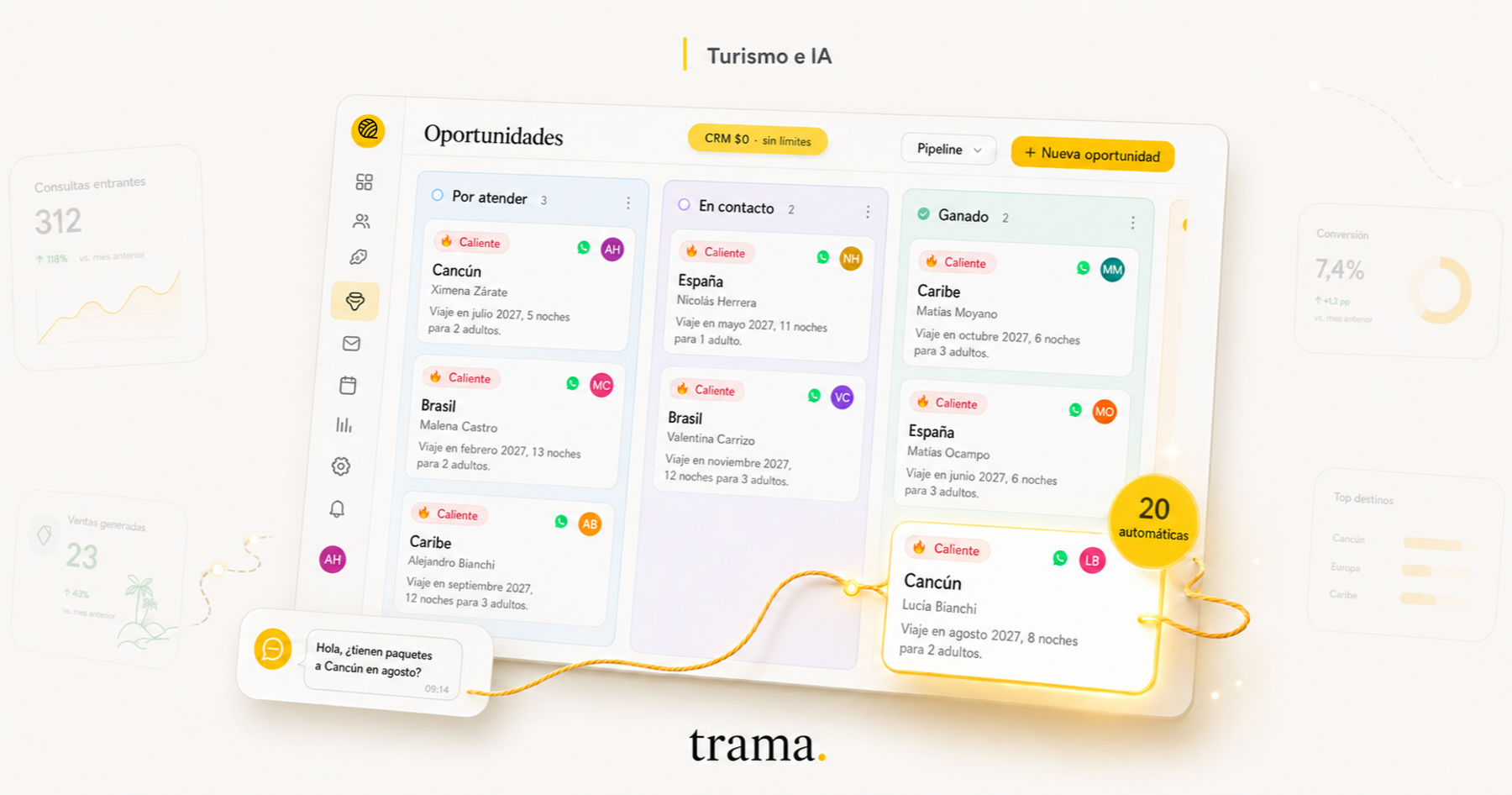
The AI agent (the same one, not a demo version) answers on the Web Widget on your site. It replies at 11:47 p.m., asks the questions your best rep would ask, qualifies whether the inquiry is real, and logs the opportunity by itself on the board, with destination, dates and passengers, for a human to close the next day. Nobody typed anything.
And it keeps working after that, which is the part a demo never shows: it assigns a rep, sets the follow-up, picks the conversation back up if the client went quiet, and keeps adding to that person's record whatever they told you, so next time they write nobody starts from zero.
There is one more part, which shows up on no dashboard and moves the most money if you run ads: when the agent qualifies an opportunity, Trama sends that outcome back to Meta. With that, Meta stops optimizing for "conversation started", a metric that doesn't pay your bills, and starts looking for people like the ones who actually buy from you.
With one consequence worth stating plainly: only what the agent qualified travels to Meta. An opportunity you logged by hand is not reported, deliberately, because it crossed no filter. Which means the free plan organizes your business but cannot feed that loop. If you run ads, we covered that part in full in how to optimize your Meta campaigns.
That's the difference between Trama's two halves, and it's worth saying plainly: in the free part you log the opportunity; in the paid part the agent logs it, out of what the client wrote.
It's trained for travel, so nobody has to explain to it what a check-in is or why the passenger count matters. If you want to see how it works, it's on the agents page.
There is one limit on this part, which I'll cover fully in the next section, and it isn't a number: the agent answers on your site and your microsite, and the opportunities it qualifies there have no cap on any plan. Connecting it to your WhatsApp is part of the paid plans.
The dashboard and the metrics
How many inquiries came in, how many got answered, how fast, how many closed and who closed them. This is the part almost nobody has today, and the part that ends arguments based on gut feeling. We wrote a whole post on how many inquiries an agency loses every month and why nobody knows; the dashboard is that number, calculated for you.
And it isn't just the count. Every week a commercial summary is built from what's actually happening: the most requested destinations, the objections that are costing you sales, the average time to first contact, and how many quotes went out without a single follow-up. Plus the risks of the moment: the hot lead nobody picked up, the quote going cold.
With one caveat I'd rather give you myself before you find it: the analysis is only as good as the data it has. On the free plan that data comes from what you logged, so the summary will be as complete as your discipline was that week. With the agent it comes from every conversation that came in, with nobody typing. The dashboard is the same one; what changes is whether it's full.
Your entire team
Unlimited members. On the free plan and on every other one. You will never have to pick which two reps get the system.
This is deliberate, and it's the direct counter to the per-user model: a CRM works when everyone is inside it. Charging you to add the person who handles the most inquiries is charging you to make it work.
The Academy
The training material (how to use the tool, how to write so the agent responds better, how to read the numbers) sits behind no plan at all.
The free plan has one limit, and it isn't a number
Every free plan has a limit. Trama's is this: the agent answers on your site and your microsite, not on your WhatsApp. There is no monthly quota of opportunities. Not on the ones you log yourself, and not on the ones the agent builds on its own. It's worth understanding exactly what that means, because it's the part people most often get wrong.
First: there is no opportunity quota
Whether you log them or the agent builds them, there is no monthly number that runs out. They don't take a slot, they're never locked, and nobody's contact details are ever hidden. If your agency takes 200 inquiries a month through the chat on your site, the agent will answer, qualify and log all 200. And all 200 the month after.
What's bounded isn't how many, it's where. The agent gets into two places for free: the chat on your site and your microsite. What it qualifies there is unlimited and is never billed, on any plan, paid ones included. What you pay for is letting it into your WhatsApp, your Instagram or your Messenger. That's a channel, and the free plan includes zero.
What a qualified opportunity is, then
It's worth having the definition anyway, because it's the unit the paid plans are measured in. It isn't every message or every person who writes in. It's a qualified opportunity: someone who asked about a trip and from whom the agent has already pulled enough that it's worth a rep picking it up: destination, approximate dates, real intent.
The person who types "hi" and vanishes doesn't count. The person asking about a job opening doesn't count. It's a measure of real leads, not of traffic.
And there is never a charge
This is the part I most want to be clear about. An account on Trama's free plan is never charged. Ever. No overage, no per-extra-opportunity fee, no surprise invoice in the month you happened to do well.
And it isn't a promise, it's a consequence of how the pricing is built: the only thing we bill for is what the agent qualifies on a messaging channel, and the free plan includes none. There is nothing to meter. You can spend two years on the free plan, have the best month of your life, and your card will not exist in our system. Nor is there a per-message fee, a per-conversation fee, or a charge for an invited user.
What a real inquiry looks like, from both sides
Everything above is description. Here's the same inquiry told twice: first the way you'll work it 90% of the time on the free plan, then the way the agent works it in the sample.
By hand, which is the free part with no ceiling
An inquiry comes in over WhatsApp on a Saturday night. Monday morning someone on your team reads it, opens Trama and creates the opportunity: client name, Cancún, January 10th to the 20th, two adults, estimated budget. They assign it to a rep and set a follow-up for Wednesday.
That's it. It's what you already do in the spreadsheet, except now the opportunity has an owner, has a state, doesn't vanish when the rep leaves, and feeds a dashboard that tells you at the end of the month how many came in and how many closed. No limit on how many you log, no limit on how many people use it, no expiry date.
The cost isn't money: it's that someone has to do it, and that someone is available Monday to Friday during office hours. The Saturday 11:47 p.m. inquiry waits until Monday, and the client doesn't.
Automatically, which is what the agent does on your site
Now the same inquiry, but arriving through the chat on your website.
It's 11:47 p.m. on a Saturday. Someone saw one of your Cancún reels, landed on your site, and typed into the chat bubble in the corner: "hi how much is cancun in january for 2 people".
The first thing that happens is that they get an answer. Then, not on Monday. The agent greets them in the tone you configured, and instead of throwing out a bare price it asks the two or three questions a good rep asks: what exact dates they're looking at, whether it's just the two of them, whether they want all-inclusive or something more flexible. The person replies: January 10th to the 20th, two adults, all-inclusive.
That's already an opportunity. Not a message: an opportunity, with Cancún as the destination, January 10 to 20 as the dates, two passengers and a noted preference. Nobody typed anything.
If you loaded a Cancún package into your catalog, the agent uses it: it knows what you sell and on what terms, so it can answer with something real instead of "I'll send you info on Monday". If you want, it sends the Offer Link with the two or three packages that fit, instead of eight screenshots.
Sunday morning you open the board. The opportunity is there, with the rep it landed on, in the "to handle" state, with the whole conversation inside it. Your rep doesn't open with "where would you like to travel?": they open from the point where the client already said everything. That's what moves conversion.
On Monday, that same person writes again. The system recognizes them: not a new contact, but the Cancún-in-January one, with their full history. And if they ask about Brazil in September, it'll still be the same record.
Neither route ends up anywhere different: in both cases the opportunity is logged, with an owner and a state. What changes is who did the logging, and what time the client found out you existed. That's what you're comparing when you compare the free plan to a paid one: not one feature list against another.
How to get your agency organized this week, without paying anything
- 1
Create the account and set up your organization
It takes a few minutes and asks for no card. All you'll define is your agency's name and what you sell, which is what the agent later uses to know what it's talking about.
- 2
Log this week's open inquiries by hand
Don't import three years of history: take the inquiries you have live today and log them as opportunities, with destination, dates and an assigned rep. This is the free CRM and it has no cap, so log all of them. In an hour you'll have your whole week in one place instead of spread across five phones.
- 3
Invite the whole team, not your two best reps
Members are unlimited, so there's no reason to leave anyone out. A CRM works when every inquiry is in the same place; with half the team outside it, the numbers you look at next week will be wrong.
- 4
Load five packages, not fifty
The classic mistake is trying to upload your entire catalog before you start. Load the five you sell most, with real prices and real terms. That's already enough for your team to stop digging through email for the PDF and to put together a decent Offer Link.
- 5
If you want to see the automatic part, paste the Widget into your site
This step is optional and it's the only one that touches what we charge for. It's one line of code for your website; if someone else built your site, send them the snippet. From the moment it's live, anyone who lands and asks something at eleven at night gets an answer and is logged as an opportunity with nobody typing. There's no quota: the ones that come in there are all yours and are never billed.
- 6
Touch nothing for seven days, then open the dashboard
Let it run for a week without optimizing anything. Then open the dashboard and look at three numbers: how many inquiries came in, how long they took to get answered, and how many were left without follow-up. That's the real diagnosis of your sales process, and it's probably the first time you'll have seen it.
When the free plan stops being enough
I'm not going to tell you the free plan is enough for everyone, because it isn't. But notice that none of the four reasons below is "my CRM filled up": the manual CRM doesn't fill up. They're all versions of the same thing: the moment came to stop logging it by hand. Reference prices are on the pricing page, and paying yearly costs ten months instead of twelve. Every price in this post, ours and everyone else's, is the one in force in July 2026.
You want it to answer your WhatsApp
This is by far the most common one, and it's the free plan's hardest limit: it includes zero messaging channels. The agent answers on your website and your microsite, not on your WhatsApp.
And in Latin America WhatsApp isn't one channel among several: it's the channel. If 90% of your inquiries arrive there, the free plan will help you organize and measure, but not answer. For that the step up is Starter: US$99 a month, one channel of your choice (WhatsApp, Instagram or Messenger) and 80 qualified opportunities a month on that channel. The ones that keep arriving through your site and your microsite don't count against that number, on any plan. Each additional channel after that is US$10 a month.
You want the work done, at any hour
This is the real reason, and it isn't a count of minutes saved. Logging by hand has two costs, and time is the small one.
The big one is that manual logging is only as good as the memory of whoever does it. The inquiry that came in on Saturday night gets logged on Monday, if someone remembers. The one that arrived while your rep was in a meeting never gets logged at all. And back to the number from the start: 78% of people buy from the first company that replies. Every inquiry that waits until Monday has already picked someone else.
An AI employee doesn't forget, doesn't sleep and doesn't have Mondays. And it doesn't stop working when the conversation ends: it carries on with the follow-up, with each rep's day and with the client's record. The way to know whether it's worth it is to look at how many of your inquiries arrive outside office hours, and how many of your quotes go cold with nobody picking them back up. If it's a lot, what will run short isn't a quota: it's having the agent only on your site. The steps count only what it qualifies on your messaging channels: 80 opportunities on Starter, 250 on Pro (US$199 a month) and 600 on Business (US$449). Past that number there is an overage, and it gets cheaper the higher the plan: US$2.50 per opportunity on Starter, US$2 on Pro, US$1.50 on Business.
You don't want it saying Trama made it
On the free plan and on Starter, the widget's chat and your microsite carry a small line of attribution saying they're built with Trama. Plenty of agencies don't care; some, especially the ones running a strong brand of their own, do. Removing it is part of Pro.
You want your team getting alerts on their own WhatsApp
Having a rep receive "you've got a new Cancún lead" on their own WhatsApp, and being able to reply to the agent from there, requires a linked team number. Starter includes three, Pro includes seven, and each additional number is US$19 a month. Pro also allows coexistence, which means using the WhatsApp your team already has without changing numbers.
What Trama doesn't do
Everything above is what it does do. This is the other column: the product's limits, stated here instead of discovered by you in month three.
Trama is not a booking engine. It doesn't issue, doesn't book, doesn't invoice, and doesn't replace your tour operator or your back office. It organizes and handles the commercial part: from the moment someone asks to the moment there's a sale ready to close. From there on you carry on with what you already use.
The free plan does not solve your WhatsApp. I'm repeating it because it's the most frequent misunderstanding. If what you urgently need is for someone to answer WhatsApp messages at 3 a.m., the free plan doesn't do that. It will organize your process and show you the hole, but plugging it requires a channel, and a channel requires paying.
The agent doesn't close the sale. It answers, asks, qualifies and organizes. The advice, the negotiation and the close are your team's. If you're shopping for something that sells without people, this isn't it, and I'd be suspicious of anyone telling you theirs does.
If you sell ten trips a year, you need none of this. At that volume the spreadsheet works and your memory is enough. This starts making sense when inquiry volume passes what one person can hold in their head, roughly somewhere north of thirty or forty a month.
And there's a part that is genuinely your work. Loading the catalog with real prices, telling the agent how you want it to speak, opening the dashboard once a week. It isn't much, but it isn't zero. Any tool promising you results without touching anything is selling you smoke.
Is Trama's CRM free forever, or is it a trial?
It's a permanent free plan, not a trial with an expiry date. Every new account is born on the free plan and stays there until it decides to move to a paid one. If you ever cancel a paid plan, you land back on the free plan instead of losing access to your data.
Do you ask for a credit card to get started?
No. The free plan asks for no payment method, and an account on that plan is never charged: no overage and no surprise fees. You only enter a card if you decide to move to a paid plan.
What exactly does the free plan include?
A complete traditional CRM for working by hand: unlimited logging of clients, opportunities and follow-ups, with no contact ceiling and no user ceiling. Plus an unlimited product catalog, the Offer Link, your microsite, the dashboard and metrics, unlimited team members and the Academy. And the AI agent answering on your site's Web Widget and on your microsite: the opportunities it qualifies there are unlimited and are never billed, on any plan.
How many opportunities can I log on the free plan?
As many as you like, whether you log them or the agent does. There is no cap: you can log 200 opportunities a month, and another 200 the next month, without paying anything. What we charge for isn't the number, it's having the agent answer on a messaging channel of yours (WhatsApp, Instagram or Messenger), and the free plan includes none.
Does the free plan hide a lead's contact details until I pay?
No. Nothing is hidden: the contact details, the whole conversation and the full record are visible from the very first lead, no matter how many come in. Nor is there an opportunity number past which something locks. What the free plan doesn't include is a messaging channel of your own, and you know that going in: it isn't a wall that shows up mid-month.
Is it useful if I only sell over WhatsApp?
For organizing and measuring, yes: you log the inquiries by hand and have your whole process in one place, free. For having the agent reply on your behalf, no: the free plan includes zero messaging channels, so it answers on your website and your microsite but not on your WhatsApp. Connecting WhatsApp starts on the Starter plan, which includes one channel of your choice.
How many salespeople can I add on the free plan?
All of them. Team members are unlimited on every plan, the free one included. We don't charge per user, because a CRM missing half the team shows numbers that are no use to anyone.
Do I need to be technical to set it up?
No. Creating the account and loading the catalog happen in the browser, with nothing to install. The only part that touches your website is pasting one line of code for the Widget, which you can hand to whoever built your site. If you don't have a site, Trama's microsite works as your page and needs nothing technical.
Can I take my data with me if I stop using it?
Yes, your customers and opportunities are yours and can be exported. It's always worth asking, and especially worth asking before you start loading months of information into any tool.
One last thing
If you got this far, you're probably evaluating tools. Let me suggest something before that, which requires neither Trama nor anything else.
Sit down for an hour this Saturday. Open your team's WhatsApp accounts and count how many new conversations came in last month. Then count how many sales you closed in that same month. Subtract. That number, how many people asked and didn't buy, is the most honest diagnosis of your sales process you're going to get, and it costs nothing.
If that number looks reasonable to you, bookmark the post and carry on as you are. That's a perfectly valid answer.
And if it bothers you, then it's worth looking at tools. You can start free with Trama and use the CRM, the catalog, your microsite and the agent on your website without paying or leaving a card, and see what happens over a month with your real inquiries. If it helps, you know where the plans are. If it doesn't, you still have the number, which was the important part.

Yaco Peralta
Co-founder & CEO, trama.
Construyendo trama. para que las agencias de viajes vuelvan a tener foco en la asesoría humana.
More posts by Yaco Peralta