A year ago the question in any travel industry meeting was whether artificial intelligence was any use to a travel agency. Not anymore. By now almost everyone has tried something, and the question has changed: why did it work for some and leave others with one more tab open in the browser.
The difference is almost never the tool. It is which part of the work it lands on. There are three different places AI enters an agency, and they are worth going through in order, because each one pays back something different: the first gives you back hours, the second gives you back inquiries, and the third gives you back sales.
First wave: the AI that gives you back desk hours
This is already happening in every agency, usually with no plan and sometimes in secret: somebody opens ChatGPT in another tab and gets something done. That is fine, it works, and it is worth doing properly rather than on the sly. These are the tasks where it really pays:
- Writing the texts you write by hand today. The package description, the Instagram post, the ad copy. It is everyone's first use and the fastest one to notice.
- Putting the day-by-day itinerary together. You hand it the services (flights, hotels, transfers, excursions) and it writes the tidy version the traveller wants to read. The content is still yours.
- The week's social pieces. Three variants of a flyer instead of one, in the sizes you use: feed, story and the image you send over WhatsApp.
- Translating without it sounding off. The same package for a Brazilian traveller, or a wholesaler's material that arrives in English.
Two rules that apply to all of the above
Never ask it for the data you already have. Price, availability, terms, the actual itinerary: you give it those. If you ask, it invents them, and it invents them in convincing prose. AI writes, it does not quote.
The prompt that worked is an asset: save it. The difference between an agency that says it uses ChatGPT and one that gets value out of it is that the second has six saved instructions that work, with the house tone baked in, and reuses them every week instead of writing from scratch each time.
This gives back real hours and is worth starting this week. What it does not do is touch the place where sales are lost, and that is why it is not enough.
Second wave: the AI that answers when you cannot
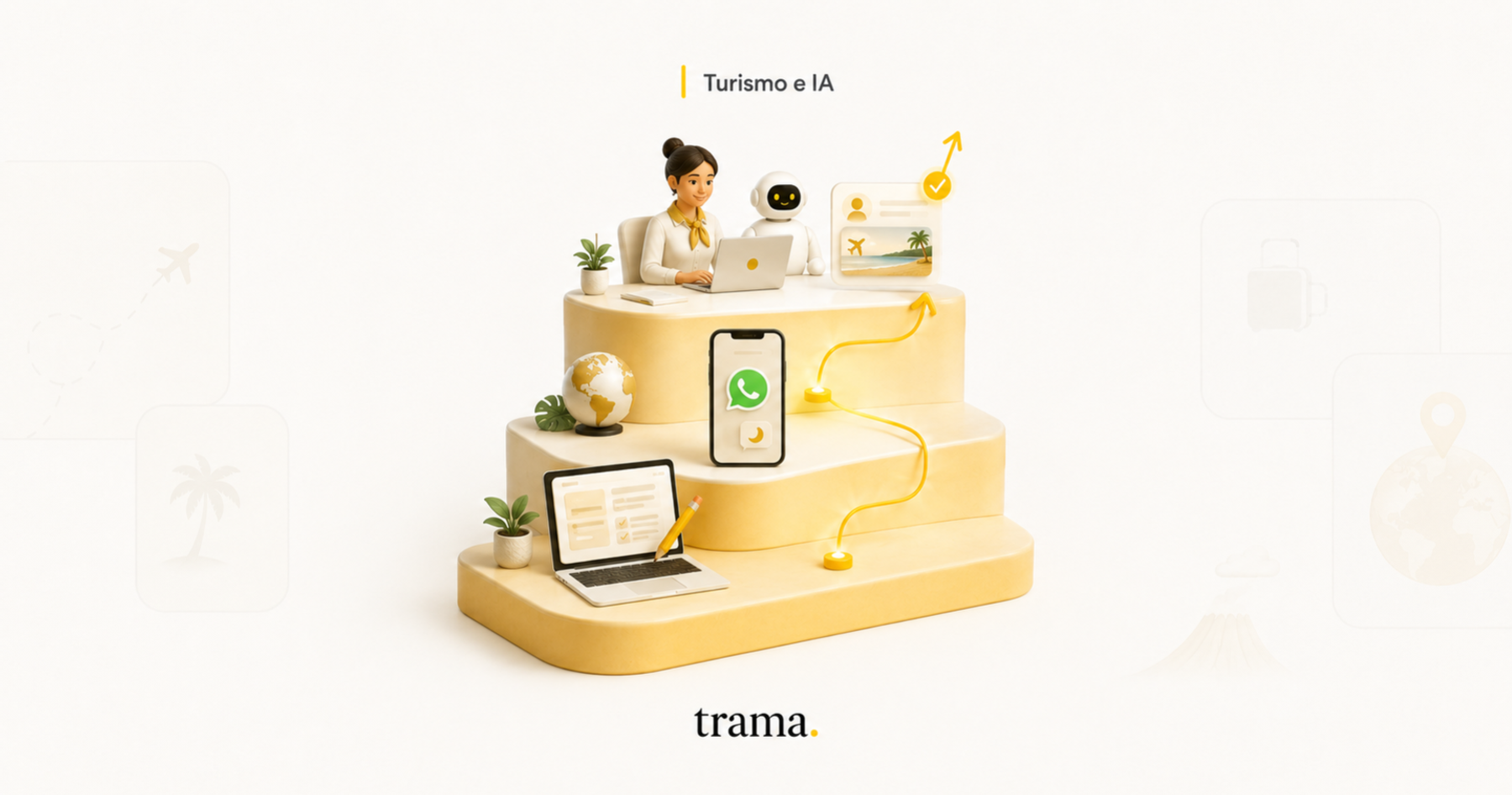
An agency's problem is almost never the writing. It is that the inquiry that lands at 11:40 on a Tuesday night waits until morning, and by morning the person has quotes from somewhere else. An AI that asks the three missing questions at 11:41 is not replacing anyone: it is covering the shift nobody can cover.
The quality gap here is wide, so it helps to know what to ask for. An AI that answers has to do three things a menu of options does not: understand what the person wrote even when it is not in any script, know what the agency actually sells, and have it written down when it stops answering and hands the conversation to a salesperson.
And there is an architecture decision worth taking early: the agent answers on an agency number dedicated to that, not on a salesperson's phone. That is what later makes it measurable, segmentable, and lets it hand over without writing on top of anyone.
Third wave: AI as one more member of the team
This is the invisible one and the one that changes the result most, because it attacks the stretch where sales actually fall through: the one between the inquiry and the quote. The one that writes the customer record while the salesperson talks, that builds Monday's follow-up list, that flags a deposit due on Friday, that does not let an inquiry sit without an owner.
What ended up making sense to us is to stop thinking of AI as one thing that answers WhatsApp, and think of it as an assistant per function, each with access to what that function needs:
- For the salesperson. The one they ask from their phone what was discussed with Laura two weeks ago, ask for the follow-up draft, and leave the deposit reminder scheduled. Without opening a screen.
- For whoever runs the catalogue. Loading products, keeping rates current and answering what is available for a given date and budget.
- For whoever watches the inbox. Which conversations went unanswered, which ones are hot, which one went cold without anyone noticing.
- For whoever distributes the work. Who has what, how loaded each salesperson is, who should get the next lead.
- For management. What happened this week against last week, without opening a spreadsheet or asking anyone for the number.
It is the same technology as the second wave, pointed inward. And it is the one that looks worst in a demo, because it has no pretty screen to show: it has a salesperson asking their phone something and getting the answer in ten seconds.
What an operation looks like when it is working
Three numbers instead of adjectives. They are medians measured across the conversations of around ten travel agencies on a normal working day:
- Five messages from the agency, end to end. That is the median of an inquiry that ends up qualified. Five well-placed messages, not a forty-message chat.
- Two of those five are enough to know whether the inquiry is real. The opening stretch, working out what the person is after and whether they mean it, is short and the most mechanical of all. Which is why it is the first one worth delegating.
- An inquiry nobody touched in four hours is already at risk. That is the deadline we alert on by default, and it is still generous: the stretch between someone asking and someone answering is where most of it is lost.
If you want the operational detail on all of that, it is in three separate articles: how to organise selling on WhatsApp, which messages get sent and which need Meta's approval and what all of it costs.
This is not a travel thing
Worth looking up for a second, because the pattern is not ours. It repeats in any trade where the bottleneck is the same person: someone with judgement and years behind them who also has to get through a pile of repetitive work before they can use that judgement.
In law, exactly the same thing is happening. Laurel, by LexGate, is an AI platform for Argentine lawyers: it searches case law and codes with verifiable sources, summarises long case files and drafts the first version of a filing. Its tagline translates as "More artificial intelligence. More of a lawyer than ever", which is our own thesis with one word swapped, and we do not think that is a coincidence.
In both cases the AI never touches the decision that defines the trade. It does not choose which hotel suits a family travelling with a two-year-old, or what strategy a case should take. It eats the part no professional misses: searching, sorting, summarising, drafting the first version, not losing track of twenty open matters at once. And in both, what it gives back is time for the part the client is actually paying for.
When the same move shows up in two trades that have nothing in common, it stops being one industry's fashion and starts looking like how work is going to be done.
The four mistakes that make people conclude it does not work
- Buying a decision tree and calling it AI. The "press 1 for packages, 2 for flights" understands nothing: if the person writes something that is not on the menu, it jams. And the traveller notices on the first message, which is exactly the worst moment. It is one of the five lies people tell about AI in travel, and the most expensive one.
- Putting it to work without telling it what the agency sells. With no catalogue loaded, no rates and none of the house rules, any model answers generically or makes things up. The boring work of loading what you sell is what decides whether the AI sounds like your agency or like a brochure.
- Not defining when it stops answering. An AI with no handover criteria either hands over everything or nothing, and both are expensive. Write it down as a data minimum: our default for a travel agency is that name, destination and dates have to be there before the conversation goes to a person. Every agency raises or lowers it, but it has to exist.
- Measuring nothing before starting. If you do not know how many inquiries came in per month or how long you took to answer, in ninety days you will not be able to say whether it worked, and the argument will be settled by impression. Two numbers written on a piece of paper before you start are worth more than a dashboard afterwards.
The part that does not get automated
The traveller calling because their flight was cancelled with the family already at the airport does not want to talk to a system. Neither does the couple spending two years of savings on one trip. That conversation is the job, and it is the reason an agency exists at all when the whole world is one click away.
We wrote about that separately: AI does not replace the travel agent, it gives the human part back. The three waves all point the same way: the first takes the desk work off them, the second takes the night shift, and the third takes the mental accounting of twenty open customers. What is left is the conversation, which is the only thing nobody else can have with that traveller.
How to bring artificial intelligence into a travel agency
- 1
Pick one desk task, the one that bores you most
Writing itineraries, writing the package descriptions, or building the week's social pieces. Just one, the one you do every week and that eats more time than it is worth.
- 2
Give it your data, do not ask for its own
Hand it the real services, your own texts, the terms you already have written down. Price and availability are never asked for: they are given. A model missing a fact fills it in anyway, and it sounds right.
- 3
Save the prompt that worked
When an instruction gives you something usable, save it with the house tone baked in and reuse it. Six saved prompts pay off more than any expensive subscription.
- 4
Only then look at the channel
With the desk hours already recovered, the next question is what happens to the inquiry that lands at eleven at night or on a Sunday. That is the jump from saving time to not losing sales.
- 5
Write the data minimum for handing over to a person
What has to be gathered before a salesperson enters the conversation. Name, destination and dates is a reasonable starting point. What matters is that it exists, that it is written down and that it is the same for the whole team.
- 6
Compare two numbers at thirty days
How long you take to give a first useful reply and how many inquiries end up with the minimum data to quote. Write them down before you start. If neither moved after thirty days, the problem was somewhere else and it is better to know quickly.
What can I ask an AI to do in my travel agency today?
With nothing connected and from day one: write a package description or the week's post, put the day-by-day itinerary together from the services you already sold, generate flyer variants for feed, story and WhatsApp, and translate material that reaches you in another language. What you should never ask it for is prices, availability or terms: you give it those.
Is artificial intelligence any use to a small travel agency?
Yes, and sometimes more than to a big one. The first wave does not depend on size: a two-person agency suffers the rate sheet and the itineraries just the same. And in the second, a small agency is exactly the one with nobody on duty at eleven at night, which is where inquiries are lost.
Will the AI talk to my customers without me seeing anything?
No, and it is worth understanding how that is arranged before you sign anything. The agent answers on an agency number dedicated to that, not on a salesperson's phone, and everything it says is recorded in the conversation the team sees. What defines how far it goes is not an emergency button: it is a written handover criterion, meaning which data has to be gathered before the conversation goes to a person. Once that is met, the salesperson continues.
Does it replace salespeople?
No, and whoever promises that has never sold a trip. The decision that defines the trade, what suits this family with this budget on these dates, is not made by a model. What gets automated is what comes before and around it: the desk work, the missing questions, the record, the follow-up, the reminder nobody sent.
How long before you see a result?
The first wave shows up the same week, because it is time you stop losing to desk work. The second shows up in the time to first useful reply and in how many inquiries reach the minimum data to quote, and that is measured at thirty days. The third is the slowest to see and the one that changes the result most.
Is this only happening in travel?
No. The same move shows up in any profession where someone with judgement loses half their day to repetitive work. In law, for example, there are platforms like Laurel, by LexGate, which searches case law with verifiable sources and drafts filings for Argentine lawyers, with the same underlying idea: the AI does the groundwork, the decision stays with the professional.
What do I need before starting?
For the first wave, nothing: an account and a chosen task. For the second and third, three things, none of them technological: what you sell loaded somewhere, a written criterion for when the conversation goes to a person, and two numbers from last month to compare against.

Yaco Peralta
Co-founder & CEO, trama.
Construyendo trama. para que las agencias de viajes vuelvan a tener foco en la asesoría humana.
More posts by Yaco Peralta