There are three messages every travel agency sends every week: the follow-up on a quote that got no answer, the reactivation of someone who went cold, and the reminder for a deposit with a due date.
If you searched for "WhatsApp templates for travel agencies", you were probably expecting a list of texts to copy. You will find something more useful: when an approved template is needed and when it is not, how those three messages are written in production, and the timings they go out on. Let us start with the thing that decides everything else, which is also the thing that gets told worst.
The 24-hour window is not what you were told
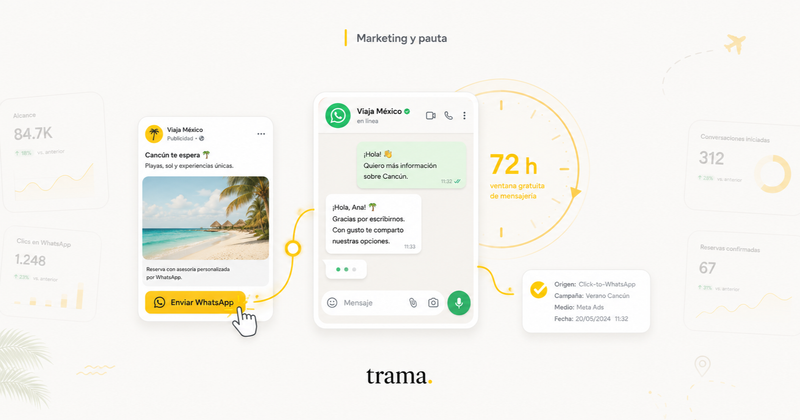
When someone writes to you, a 24-hour window opens. Inside that window your agency answers whatever it wants, with whatever text it wants, and with no cap on messages.
And the window reopens with every message the customer sends. It is not a clock that starts once with the first inquiry: it starts again every time the person writes. As long as the conversation is alive, it is open.
This is worth pausing on, because it is where half of what you read about WhatsApp Business API falls apart. "You can only write for 24 hours" does not describe any real operation. A travel sale that takes three weeks happens almost entirely in free text, because over those three weeks the person answers. Nobody sells with a one-day stopwatch, and no agency could.
The number, measured on our own production: out of 7,029 outbound messages over 30 days, 97.2% went out inside the window. Fewer than three in a hundred needed a template. That is the real size of the problem.
So here is what a template really is: the way to break a silence. It does not replace the conversation, it reopens it. And when the person answers the template, another 24-hour window opens and you are back to free text. That is the real cycle: the template is the door, not the house.
Outside the window, the message the business starts has to be a template approved by Meta in advance: it goes to review with its fixed text and its variables, and until it is approved it cannot be sent. Meta sets the exact conditions and changes them whenever it wants, so the source that counts is theirs.
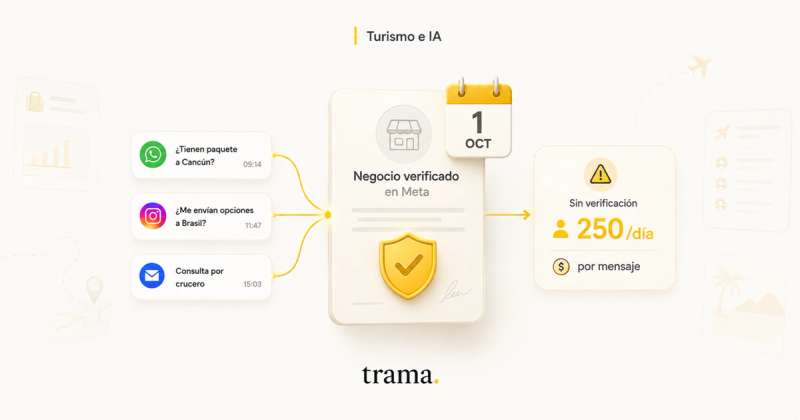
Watch utility templates from October on: through September 30, sent inside the 24-hour window, they cost nothing. From October 1, 2026 they're billed, just like any free-form reply. Getting a template classified correctly is worth more money than it used to be.
And one fact that works in your favour today and belongs on your calendar: replies inside the window are not charged, and utility templates that land inside an open window are not charged either. Meta announced that from October 1, 2026 it starts charging per message for those cases too. Until then, an inquiry resolved in a normal back and forth costs the agency nothing.
Message by message: what needs a template and what does not
The right question is not "does this message need a template?", it is how long has it been since this person wrote to me? With that, the three above:
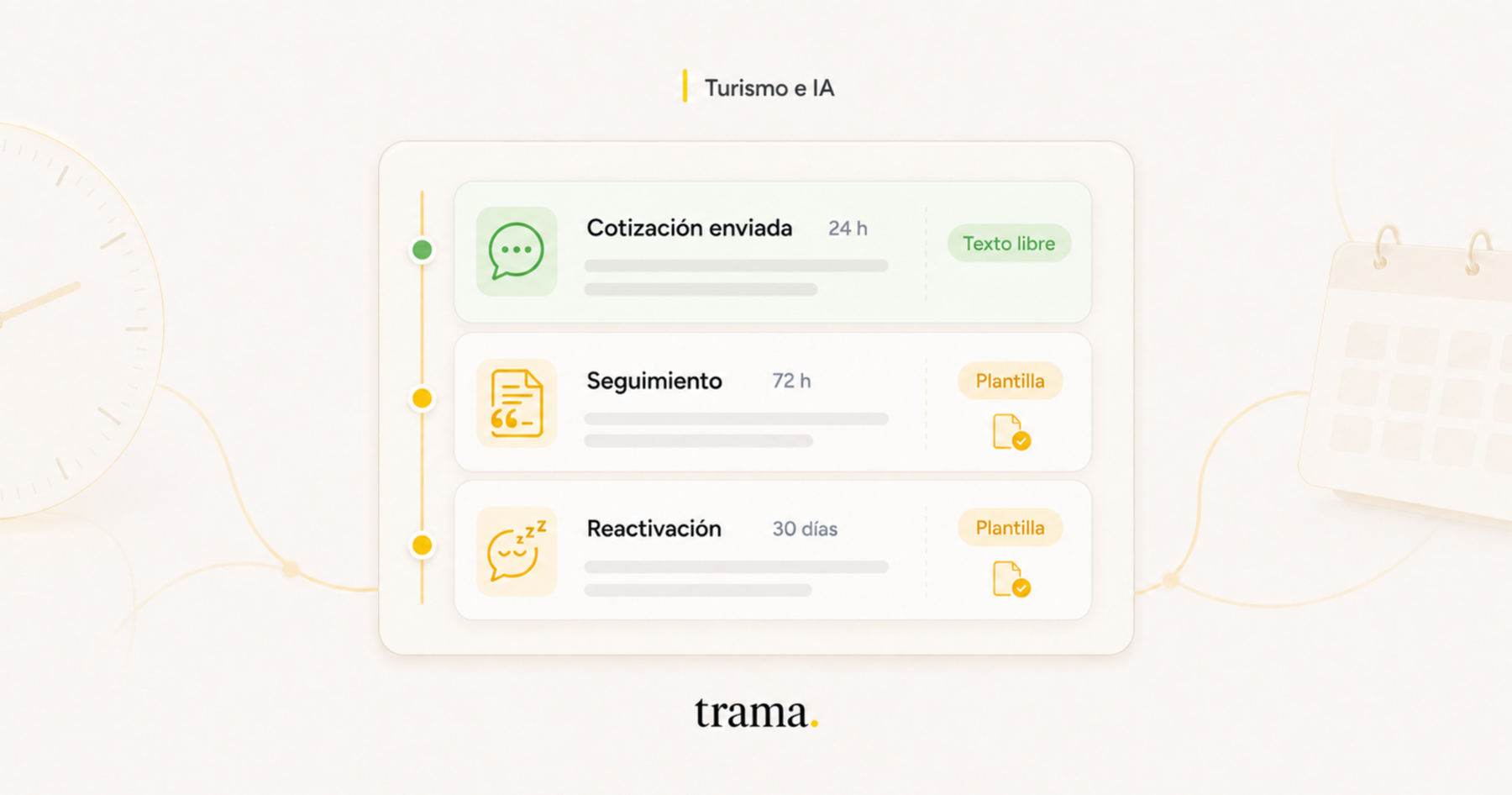
- Follow-up on a quote. If the person wrote a little while ago and said they would think about it, it is free text. If they have said nothing for three days, the window is closed and it goes out as a template. Same message, two different answers, and the only thing that changed is the clock.
- Reactivating a dormant customer. Weeks or months later there is no window left: template, no way around it.
- A deposit reminder with a due date. This is the one people get wrong most often. If you are talking right now, free text, and better: you can put in the exact amount, the real due date and the payment method, things a template with fixed variables handles badly. If you have not spoken in four days and the deposit is due on Friday, you need a template, and it is the textbook case for the utility category: a notice with a date and an amount, with nothing to promote. Waiting for the person to write first so you can tell them their booking is about to expire is not a commercial option.
It is worth spelling this out, because it is the part that gets sold badly: an approved template does not make the message work. It makes the message sendable. What makes it work is what it says.
How we write those messages
Trama's follow-up and reactivation drafts are written by a model, but not freely: it has hard rules, and those rules are the transferable part. These are the ones we use in production, as they are:
- Two to four sentences. No bullets, no headers, no signature. This is WhatsApp, not email.
- Open with the person's name. Close with a single concrete question. One. Two questions in a follow-up message lower the chance of getting either one answered.
- Pick up the actual thread. Mention destination, dates or passengers only if you have them. A generic "how is the trip planning going?" reads like a template even when it is not one.
- Never invent prices, availability, dates or conditions.
- Never reproach the person for not having answered. Writing "you never got back to me", "I was waiting for your reply", "I had no news from you" or any variant is forbidden. You do not know whether they saw the message, and writing it turns a follow-up into a complaint.
- If you have already talked, do not introduce yourself again. Pick up where you left off.
That second-to-last rule is the one that saves the most sales. Reproach is the natural reflex of whoever is waiting, and it is exactly what makes the other person never answer again.
The angle changes with the moment
The most common mistake is having a single follow-up message and using it for everything. We distinguish at least four situations, each with its own intent:
- First contact, nobody has written yet. Introduce yourself and open the conversation.
- You talked, but it never got to a quote. Nudge gently towards the next concrete step.
- You already sent a quote. Follow up in a way that adds something: clarify, adjust, offer an alternative. Without pressure.
- It has not moved in weeks. Reactivate with something of value (an idea, an option, a piece of news), without sounding desperate and without demanding anything.
The difference between "just checking if you saw the quote" and "writing because a departure came up on the 14th that fits your dates better" is not tone: it is that the second one has a reason. The first one asks the other person to do the work.
When each one goes out: the timings we use
Timing matters as much as the text, and it is the part almost nobody publishes. These are the defaults Trama runs on, configurable per agency:
- A new handed-off inquiry nobody touched. At 4 hours. It is the most expensive stretch of all: a travel inquiry that waits a day is already buying somewhere else.
- You talked, but it never got to a quote. At 48 hours. And if the conversation stalled halfway, at 5 days from the last movement.
- Quote sent, no answer. Three touches, not one: at 48 hours, at 7 days and at 15 days. After the third one with no answer, the opportunity closes itself.
- Opportunity with no activity. At 25 days a warning comes in; at 30 it is stored as dormant. It is not deleted: it leaves the active board and can be reactivated if the person comes back.
One clarification that changes how to read that list: by default, when one of those deadlines expires, the alert goes to the salesperson, not to the customer. No agency starts writing to its customers because of a decision of ours. Each one chooses which of those deadlines turn into a message and which stay as a task on somebody's screen.
Three touches and then closing is the counterintuitive part. The temptation is to keep pushing indefinitely, and what that produces is a task list nobody looks at and a salesperson who stops trusting their own list.
What nobody tells you about Meta templates
If you are going to submit templates for approval, this saves you weeks. We learned all of it by breaking things in production:
You do not pick the category. You submit the template declared as utility (transactional), and Meta reclassifies it on its own if it decides it is marketing. It is not deterministic and it is not even consistent across languages: we have templates where the Spanish version came out marketing and its English siblings came out utility, with the same text translated.
And it is not a cosmetic label. A marketing template is billed differently, and the person may also have it blocked in their preferences: an operational notice classified as marketing may never arrive.
What pushes it into marketing. The pattern we measured: a template that announces there is information reads as marketing; one that contains the information stays utility. Our weekly summary said "you can now see how the week closed and where to focus" and came out marketing. Rewritten so the message is the report, with the numbers inside it, it came out utility. The difference is a concrete piece of data in the text.
They cannot be edited. An approved template is not corrected: another one is created. If you got the text wrong, you have to register a new name and wait for review again. Write them as if there were no second chance, because there practically is not.
A verification code in the body kills it. If the visible text includes a code, Meta rejects it for the wrong category: it reads it as authentication. That data has to travel in the button, not in the text.
A marketing template with no way out does not get registered. Every marketing template has to carry a way to say "stop writing to me". In our case the code checks it before uploading: no opt-out button, no upload. It is the difference between a campaign and a spam report, and the report is paid for with the quality rating of your number, which is the one thing you cannot buy back.
What we have approved, and what for
Since this article demands precision from everyone else, here is ours. We have two families of templates and they do different things:
- The utility ones, which talk to the team. That a lead was assigned, that an already handed-off customer pushed again, that a reminder came due, that WhatsApp could not deliver a reply. They are operational notices and they never reach a customer.
- The campaign kit, which talks to customers. Five families that register themselves when the agency connects its number, so the first campaign does not have to wait for an approval: reactivating a cold inquiry, news about a destination they asked about, picking a quote back up, repeat purchase or anniversary, and a general notice. All of them marketing category and all of them with an opt-out button.
And the constraint that defines that kit, the one nobody mentions when they sell you templates: in a bulk send the variables are static for the whole send, not per person. There is no generic template with six holes that fill themselves with each person's data. The only thing that changes per person is the name; everything else has to be true for the entire segment. Which gives you the practical rule: the segment defines the template, and several small, specific segments pay off far more than one big vague one.
So if someone offers you "fifteen approved templates for travel", the three questions worth asking are: which category Meta approved them under, whether the marketing ones carry an opt-out button, and what happens when you want to change one word in one of them.
And if none of this rests on a process (who follows up on what, with what criteria and until when), templates fix nothing on their own. We go into that here: how to sell more trips on WhatsApp. What each of these messages costs to send, here.
How to write a quote follow-up that does not sound like a complaint
- 1
Check the clock before the text
If the person wrote to you in the last 24 hours, you can reply with free text. If it has been longer, the message that opens the conversation has to go out as an approved template. That is the first thing that defines what you can write.
- 2
Find the reason before writing
A follow-up with no reason asks the other person to do the work. A new date, a price adjustment, an alternative that fits the budget: anything concrete works better than asking whether they saw the quote.
- 3
Open with the name and pick up the thread
If you have already talked, do not introduce yourself again. Mention the destination or the dates only if you have them written down: inventing context shows.
- 4
Write two to four sentences
No lists, no headers, no signature. A long block of text on WhatsApp reads like advertising and gets skipped.
- 5
Remove every trace of reproach
Reread it looking for "you never replied", "I was waiting" or "I had no news". If any of those show up, rewrite: you do not know whether the person saw the message, and reproach closes the door.
- 6
Close with a single concrete question
One, not two. And one that can be answered in a line: choosing between two options is easier than composing an answer.
- 7
Decide how many times you will push, and stick to it
Three touches (at 48 hours, at 7 days and at 15) and then closing is a reasonable criterion. What matters is that it exists and that it has an end: an infinite follow-up list is a list nobody looks at.
Is it true that I can only write to a customer for 24 hours?
No. The 24-hour window reopens with every message the customer sends, so as long as the conversation is alive you can write free text with no cap. In our production measurement, 97.2% of the messages an agency sends fall inside the window. The approved template is needed to break a silence, not to have a conversation.
What is a WhatsApp template and when is it needed?
It is a message with fixed text and variables that Meta approves before you can send it. It is only needed when the business starts the conversation outside the 24-hour window that each customer message opens. When the person answers the template, a new window opens and you are back to free text.
Do I need a template to follow up on a quote?
It depends on when. If more than 24 hours have passed since the customer's last message, yes. If the conversation is still alive, no. That is why it pays to have both: the template for the scheduled send and a good standard for writing it by hand while the window is open.
Do I need a template to remind someone about a deposit or a payment?
If the person has not written in more than 24 hours, yes, and it is one of the clearest uses of the utility category: a notice with a date and an amount promotes nothing. If you are talking at that moment, free text is better, because you can put in the exact amount, the due date and the payment method, data a template with fixed variables handles badly.
Why did Meta classify my template as marketing if it is transactional?
Because Meta decides the category, not you, and it is not deterministic: it can classify the same template differently in two languages. The pattern we measured is that a template announcing that information exists reads as marketing, and one that contains the information stays utility. Putting a concrete piece of data in the text, a number, a date or a name, is usually the difference.
Can the text of an already approved template be corrected?
No. An approved template cannot be edited: you have to register a new one under another name and wait for review again. The old one goes inert. Write them as if there were no second chance.
How often should you follow up on a quote?
Our defaults are three touches: at 48 hours, at 7 days and at 15 days, and then the opportunity closes. What matters is not the exact number but that the criterion exists and that it has an end: pushing indefinitely creates a task list nobody looks at.
How much does each of these messages cost?
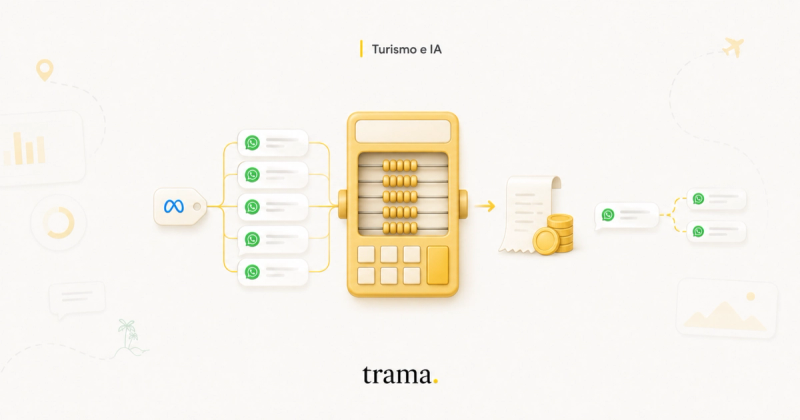
Today, replies inside the 24-hour window are not charged, and utility templates that land inside an open window are not charged either. Meta announced that from October 1, 2026 it starts charging per message for those cases too. Templates that open a closed conversation are always charged, and marketing ones are the most expensive of all.

Yaco Peralta
Co-founder & CEO, trama.
Construyendo trama. para que las agencias de viajes vuelvan a tener foco en la asesoría humana.
More posts by Yaco Peralta