"How much does WhatsApp Business API cost?" has no answer in dollars, and anyone who gives you one is simplifying something that will cost you money.
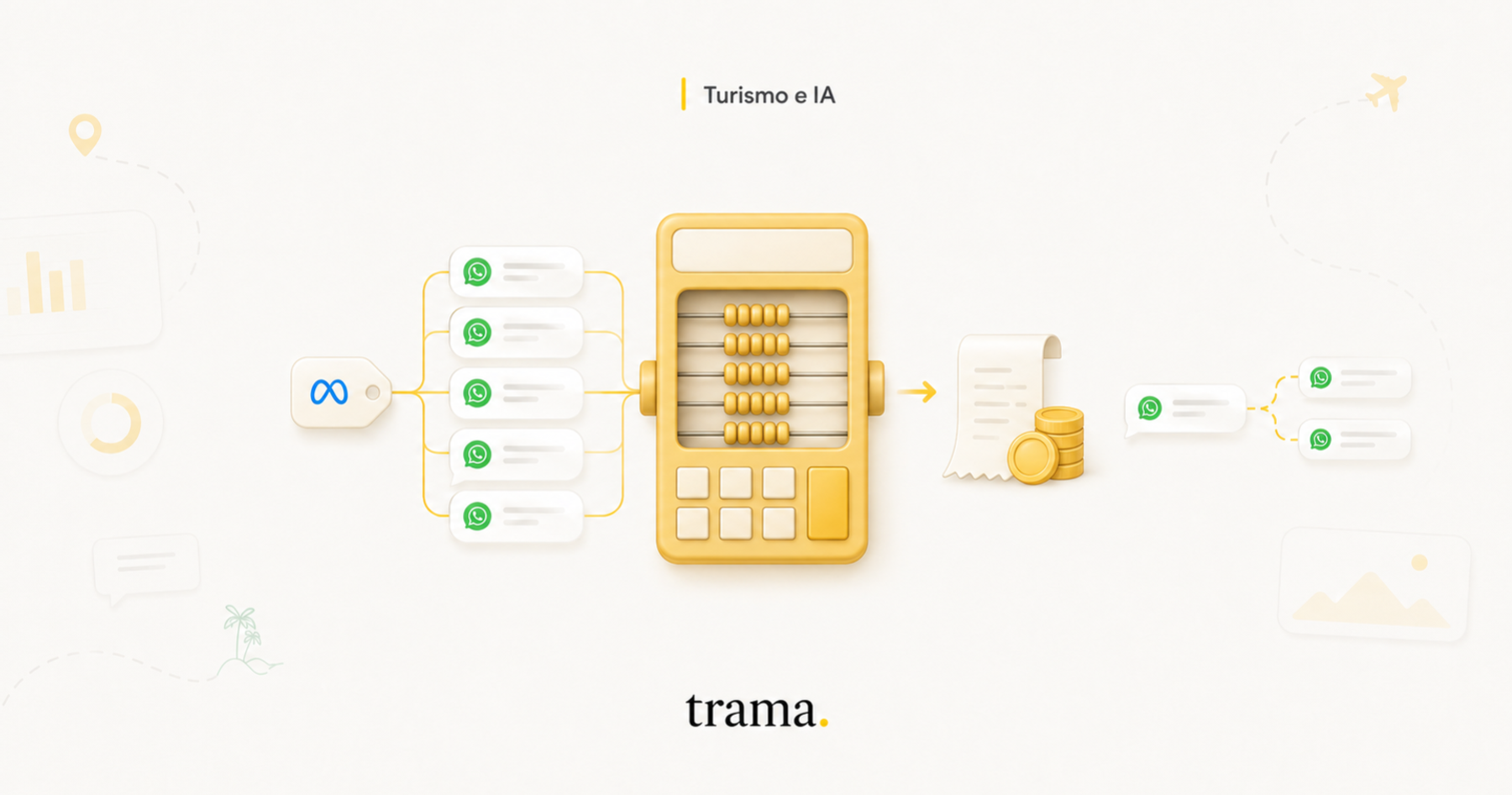
The cost is a multiplication of two factors:
what Meta charges per message (which changes by country and by message type) × how many messages your operation sends.
Nobody but Meta controls the first factor. The second one is entirely yours, and it decides whether your bill is ten dollars or three hundred. This article is about both, and about why almost everyone gets the second one wrong.
Who charges you, and who doesn't
First things first, because it orders everything else: Meta charges you for the messages, and you pay Meta. It isn't part of what you pay for the platform you use to connect, and it shouldn't be.
At Trama it's explicit: we don't add anything on top. It's pure passthrough. The distinction is worth knowing when you compare providers, because some resell Meta's messages with a margin and present it as "all included". There is nothing illegal about that, but it pays to know which of the two models you are buying: in one, Meta's price drops when Meta drops it, and in the other it doesn't.
Meta sets the rates, the categories and the conditions, and changes them whenever it wants. That is why the only source worth citing is theirs: the WhatsApp Business Platform pricing page. Any pricing table in a blog post, this one included, is out of date the moment you read it.
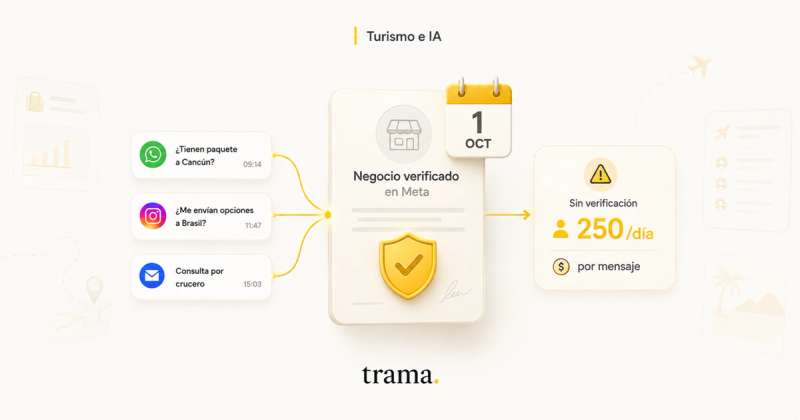
And there's one change worth holding in mind while you do this math: from October 1, 2026 replies inside the 24-hour window stop being free and get charged per message, at the country's utility rate. Exactly what gets billed, and what to do before then, in verify your business with Meta before October 1.
What changes the price: country and category
Two axes, and both matter.
The country of the person receiving the message. Not yours: theirs. The difference between markets is not 10%, it is an order of magnitude. An agency that sells to Brazilians and one that sells to Europeans have different cost structures even if they send exactly the same messages.
At Trama we model thirteen markets so we can estimate: Argentina, Brazil, Mexico, Chile, Colombia, Peru and the rest of LATAM; Spain, Portugal, Italy, France, Germany and the rest of Europe.
The message category. Meta classifies every message a business sends, and each category is priced differently:
- Service. Your free-text replies inside the conversation the customer opened.
- Utility. The transactional messages the business starts: a notice, a reminder, a confirmation. They go out as approved templates.
- Authentication. Verification codes.
- Marketing. Broadcasts, promotions, news. It is the most expensive category, and by a good margin.
And there is a detail that breaks a lot of budgets: you do not pick the category. You declare a template as utility and Meta can reclassify it as marketing if it decides the template promotes instead of informs. It happened to us with our own weekly summary. We wrote separately about how to avoid that when you write the template.
Volume discounts do not apply evenly across categories either. Which ones do and which ones do not is on Meta's page.
The half you can move: how many messages you send
Here is the number you will not find in Meta's documentation, because it is not Meta's: it is ours, measured in production.
A travel opportunity that ends up qualified takes a median of five outbound messages. Five. From the first "hi" to the handoff to a salesperson.
That number is the real unit economics. Your market's per-message rate, multiplied by five, gives you Meta's cost per qualified opportunity, which is the metric that matters: nobody invoices messages, they invoice trips.
And that is where the room for improvement is, which is enormous and does not depend on negotiating with anyone. An agency that gets to the five minimum data points (name, destination, dates, passengers, departure city) in three messages instead of nine pays a third. The lever is not the rate: it is the conversation.
The mistake of counting conversations instead of messages
This is the one that breaks the most budgets, and we measured it with our own numbers.
Meta charges per delivered message, not per conversation and not per exchange. And one reply can go out split into several messages: that is how people write on WhatsApp, and that is how a well-built agent answers.
Over thirty days of production we counted 2,283 agent turns against 2,835 outbound messages. Around 1.24 messages per turn. If you built your budget counting "conversations" or "replies", you are missing close to a quarter of the bill.
What is not charged: the messages the customer sends. Only what leaves the business is charged. A conversation where the customer writes fifteen times and you answer four costs four.
Broadcasts: another order of magnitude
If on top of answering inquiries you are going to send campaigns (a promo, the opening of a season, reactivating old passengers), the math is different and it is worth doing beforehand.
It is linear and it does not forgive: contacts reached × sends per month × marketing rate. No tiers, and with the most expensive rate of all. A base of five thousand contacts with two sends a month is a line item of a different magnitude than answering inquiries, and it is the reason many agencies discover the cost of WhatsApp only when they send their first broadcast.
That is not an argument for skipping them. It is an argument for keeping the list clean: you pay per contact reached, not per contact interested.
How to estimate it for your case
Three steps, and none of them requires talking to a salesperson:
- Get your rate from Meta's official pricing, for the country of your customers and for the category you are going to use.
- Estimate your messages. If you do not have the data, five outbound per qualified opportunity is a reasonable starting point: it is our median. Multiply by the opportunities you expect per month.
- Add broadcasts separately, if you are going to run them, with the marketing rate and the total contacts reached.
Our pricing page has a calculator that runs that math with the per-country rates, and a breakdown that explicitly separates what Trama charges from what Meta charges. The numbers in that calculator are estimates and are kept up to date in a single place, which is why we do not repeat them here.
What to take away
- Meta charges for the messages and Meta gets paid for them. Check that your provider does not add a margin.
- It changes by the country of the recipient and by the category of the message, and Meta decides both.
- It is counted per delivered message, not per conversation. Count on around 24% more than your intuition tells you.
- The only thing you can move is how many messages it takes to qualify an inquiry. There is far more room there than in any rate.
How you bring that number down is, at bottom, the same work that makes you sell more: putting your WhatsApp sales in order.
How to estimate the cost of WhatsApp Business API for your agency
- 1
Start from the country of your customers, not yours
The rate is applied based on where the person receiving the message is. If you sell to several markets, do the math separately: the difference between countries is an order of magnitude, not a percentage.
- 2
Look up the current rate at Meta's source
No table published on a blog works for budgeting: Meta changes the rates whenever it wants. Go to its platform pricing page and take the number for your country and your category.
- 3
Estimate the outbound messages per opportunity
Only what the business sends is charged. If you do not have your own figure, five outbound messages per qualified opportunity is our production median and works as a starting point.
- 4
Correct for messages, not for replies
One reply can go out split into several messages, and Meta charges for each one. In our measurement that is around 1.24 messages per agent turn: if you counted replies, add 24%.
- 5
Calculate broadcasts separately
Contacts reached × sends per month × marketing rate. It is linear and it is the most expensive category. Cleaning up the list lowers this line more than anything else.
Who charges for WhatsApp Business API messages?
Meta. You pay Meta directly, separately from whatever the platform you use to connect costs. Some providers resell those messages with a margin and present it as a single price; it is worth asking explicitly, because in that model a rate cut from Meta never reaches you.
Why does the price change by country?
Because Meta prices by the country of the person receiving the message, not the country of the business. The differences between markets are large: an agency selling into one market and another selling into a different one have very different costs even when they send exactly the same messages.
Is it charged per conversation or per message?
Per delivered message. It is the most expensive confusion: one reply can go out split into several messages and each one is charged. In our production measurement, 2,283 agent turns produced 2,835 outbound messages, around 1.24 messages per turn.
Are the messages the customer sends charged?
No. Only what leaves the business is charged. A conversation where the customer writes fifteen times and the agency answers four costs four messages.
How many messages does a travel inquiry cost?
In our production measurement, the median for an opportunity that ends up qualified is five outbound messages, from first contact to the handoff to a salesperson. That is the useful unit for budgeting: your country's rate times five gives you Meta's cost per qualified opportunity.
How much do WhatsApp broadcasts or campaigns cost?
They are calculated separately: contacts reached times sends per month, at the marketing rate, which is the most expensive category. It is linear, so the total grows with the size of the list with no tiers. You pay per contact reached, not per contact interested, and that is why cleaning up the list is the main lever.
Can I lower the cost by negotiating the rate?
Not with Meta. The real lever is the other half of the multiplication: how many messages it takes to qualify an inquiry. An agency that gathers the minimum data to quote in three messages instead of nine pays a third, without negotiating anything with anyone.

Atahualpa Herrera
Co-founder & CTO, trama.
A cargo del producto y la tecnología de trama. Convencido de que una buena herramienta se siente como un compañero de equipo, no como una pantalla más para llenar.
More posts by Atahualpa Herrera