In travel, the sale happens on WhatsApp. It is not a channel preference: it is where the customer is, and it is where any inquiry that starts on Instagram, in an ad or on the website ends up. An agency that wants to sell more trips on WhatsApp almost never has a traffic problem.
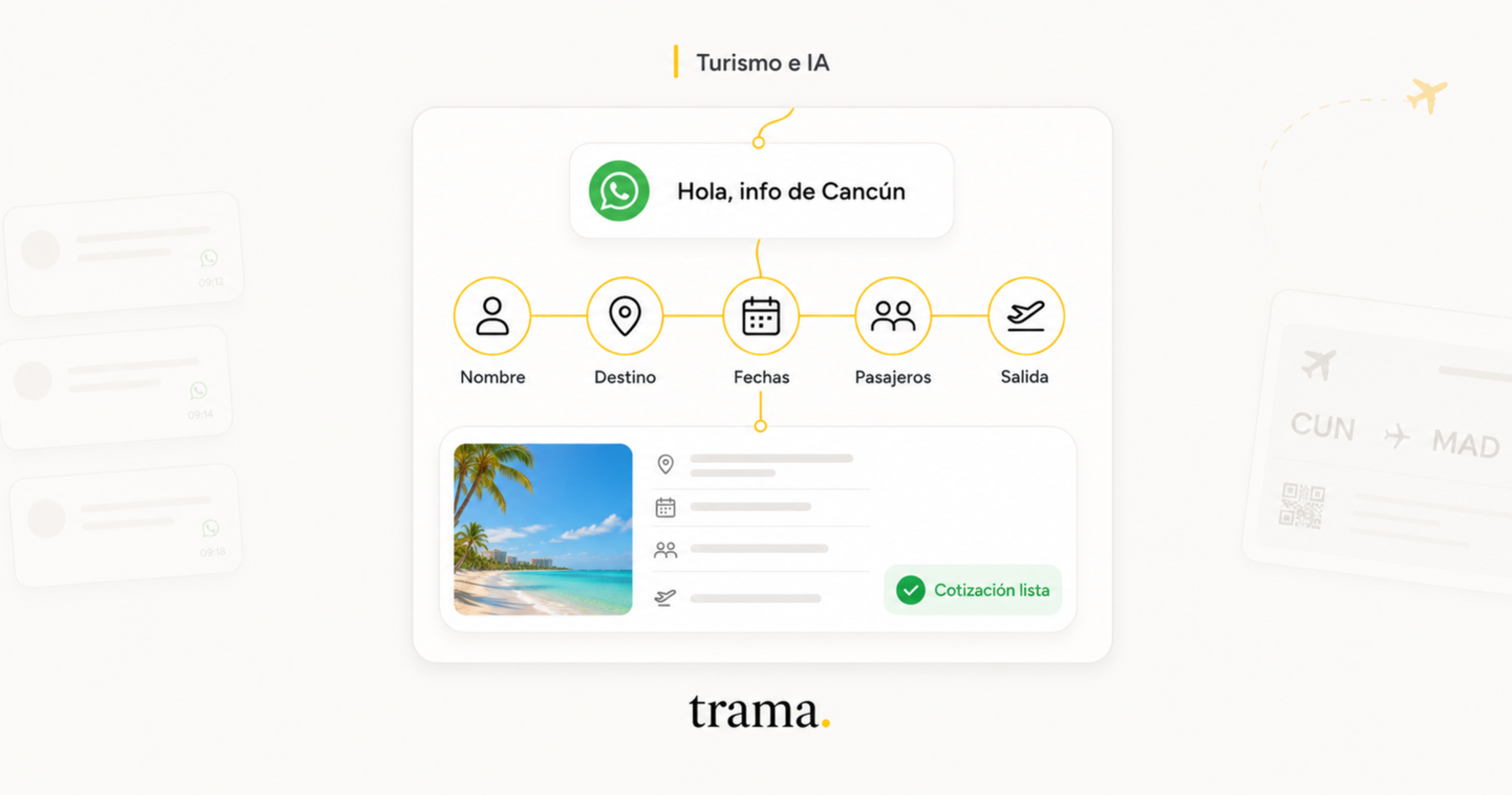
It has a middle-of-the-funnel problem: between someone writing "hi, info about Cancun" and a quote going out, there is a set of steps nobody ever wrote down, that depend on which salesperson was looking at their phone, and that get lost if that person is off that day.
This guide is about that stretch. Not about sending more messages.
The problem is not that few inquiries come in
When an agency says "we are not selling", the first reaction is usually ads: more campaigns, more inquiries. And the inquiries were almost always already there.
What happens to a WhatsApp inquiry in an agency with no process is fairly predictable:
- It lands on a phone. If that phone belongs to one person, the inquiry belongs to that person, and nobody else knows it exists.
- It gets answered fast during office hours, and otherwise tomorrow.
- Someone asks about the destination. Then, two hours later, the dates. The next day, how many travellers.
- By the time a quote is possible, two days have passed and the customer already got quotes elsewhere.
None of that is an effort problem. It is that the state of the sale lives in somebody's head and in the scroll of a chat, which is the worst possible place to store information somebody else is going to need.
We wrote separately, in more detail, about how many inquiries an agency loses every month and why nobody knows and about why the problem is not selling, it is that the process does not exist.
The five data points that separate an inquiry from a quote
This is the most concrete thing we can offer, because it is what we measure every day.
A travel inquiry cannot be quoted until five data points are in. Not four, and not ten:
- Name of the person asking.
- Destination.
- Travel dates.
- Number of travellers.
- Departure city.
With those five, any salesperson can put a proposal together. Without a single one of them they cannot, and what they do instead is send a generic price range that commits to nothing and that the customer compares against five other generic ranges.
Budget is a different, sixth data point: you do not need it to quote, but it is the one that shapes the proposal most. If you have it, you stop sending three random options and send the one that fits.
And it is worth separating two minimums that get confused all the time. The five data points are the minimum to QUOTE. The minimum to HAND the conversation over to a salesperson is lower, and each agency picks it: our default for a travel agency is three (name, destination and dates), because at that point there is already a person with a trip in mind and it is worth having someone look after them. The other two get filled in by talking. If you would rather nothing reached you without travellers and departure city, you raise the minimum. What does not work is not having it written down.
The operational conclusion is uncomfortable but simple: the first conversation is not a chat, it is a friendly form. The agency that sells more on WhatsApp is not the one that writes best: it is the one that gets to the five data points in the fewest messages, without it showing.
A single message is not an opportunity
There is a temptation to count everyone who writes as a "lead". It is an expensive mistake: it inflates the numbers, fills the board with dead inquiries and makes the team stop trusting the board.
Our rule: an inquiry only starts counting once the person has replied after the agency's first answer. A single message, especially the pre-filled text of an ad, which already has the destination written in it, proves nothing. And waiting for that second message costs no real time: whoever was going to answer answers right away.
Follow-up is the job, not the extra
Most travel sales do not close in the conversation where they started. They close three days, two weeks or two months later, and what happens in between is follow-up.
And follow-up is the first thing that falls off when volume goes up, because it is not urgent. Nobody complains about the follow-up you did not do. You just do not sell, and you never find out why.
Three moments hold almost all of the value:
- After sending the quote. Silence is not a "no". It almost always means the person is comparing or checking with whoever is travelling with them.
- When an old customer becomes a possible customer again. Someone who travelled with you a year ago is infinitely cheaper to reactivate than a stranger from an ad.
- When there is a deposit pending and a due date. A booking that falls through for lack of a reminder is a sale that was already made.
All three are solved with concrete messages, and those messages are more alike across agencies than you would expect. We publish them separately, along with the ones we use: the messages a travel agency actually sends on WhatsApp.
Selling on WhatsApp has rules of its own
Here it helps to separate two things that share a name.
The WhatsApp Business app is the one you download onto a phone. It is free, it is enough for a one-person agency and there is nothing wrong with it. What it does not have is a shared inbox, customer history, or a way for two people to work the same number without stepping on each other.
The WhatsApp Business API is how a system connects to the agency's number. It is what CRMs and messaging platforms use. It enables the team, the history and the automation, and in exchange it adds two rules worth understanding before you sign anything:
- To write first, you check the clock. When someone writes to you a 24-hour window opens in which you reply freely and with no cap, and that window reopens with every message the customer sends: as long as the conversation is alive, there is no obstacle. Outside that window, the message the agency starts has to be a template approved by Meta. In our measurement, 97.2% of what an agency sends falls inside the window: the template is not the normal way of talking, it is the way to break a silence.
- Meta charges for the business's messages, not your provider. You pay Meta, at its rate, which changes by country and by message type. We add nothing on top. There is also a detail worth having on your calendar: replies inside the window are not charged today, and Meta starts charging for them on October 1, 2026. The current rates are on Meta's pricing page.
What that adds up to in practice depends less on the rate than on how many messages your operation sends. We go into it here: what WhatsApp Business API costs for a travel agency.
And there are rules that change by market. Meta restricted, for instance, businesses outside Brazil starting conversations with Brazilian numbers, something that changes how an inbound operator works and that almost no agency heard about.
The numbers: one for the agent, one per salesperson, none personal
This is where most guides say one of two things, and both are wrong. The first is leaving the sale scattered across the team's personal phones. The second, usually offered as the cure, is putting the whole agency inside a single WhatsApp. The architecture we recommend has three pieces, and neither of those is one of them:
- The agent's number. It is the agency's commercial number: the one on the website, in the ads, on Instagram, in the shop window. New inquiries land there and that is where the AI lives, connected through the API. It answers at any hour, asks the questions that are missing and hands over with the context already assembled. It is a number dedicated to that and nothing else, which is what later makes it measurable.
- One work number per salesperson. Once the inquiry is handed over, the conversation continues on the number of the person who will handle it, writing the way they always write. And here is the part almost nobody puts in writing: those numbers belong to the agency. They are handed to the person when they join and handed back when they leave, with the line and with the chats. A salesperson walking out with the client book in their pocket is not a theoretical risk: it is the most common way of losing customers who had already bought from you.
- The personal phone, never. This is not about working hours or tidiness. It is that there the agency has no history, no traceability and no number.
And the other extreme, one single number with the whole team inside it, sounds like order and is not. It fails on three fronts at once:
- It has a technical ceiling. The WhatsApp Business app allows four linked devices besides the phone, ten with Meta Verified. A sales floor of six does not fit, and the workaround of sharing the same WhatsApp Web session between everyone is already the signal that the channel is being used for something it was not designed for.
- There is nobody to attribute anything to. Every message goes out from the same account and the same number. You cannot tell who answered, how long they took or who closed. Without that there are no fair commissions, no possible conversation about performance, and no way to know who deserves more leads.
- You cannot segment. The same number serves the person asking for the first time, the one who already has a booking and the one complaining about a cancelled flight. Any conversion measurement mixes the three, and any campaign writes to all three.
What does have to be single is not the phone: it is the inbox and the history. Several agency numbers connected to the same system give you everything the single number promises, at none of its three costs:
- The returning customer. Someone who travelled in 2024 writes in 2026 and a different salesperson picks it up. If the history is on the first one's phone, the agency starts from zero with someone who already bought.
- The handover. A lead that arrives and stays ownerless goes cold. Having an assigned owner, with a name, is the difference between a follow-up and an oversight.
- The measurement. With every number reporting into the same database you can know how many inquiries came in, how many were quoted and how many closed, and by whom.
None of this requires throwing away the number you already use. It requires deciding what each line does, putting them all in the agency's name and connecting them to one place.
What to measure, if you measure nothing today
Three numbers, and none of them needs an elaborate dashboard:
- Inquiries that reached the five data points. That is your real sales volume. Everything else is traffic.
- Time to the first useful reply. Not to the "hi, I will get back to you": to the first question that moves the quote forward.
- Quotes sent with no answer after three days. That is your follow-up list, and in most agencies nobody has it written down.
If those three numbers exist, decisions about ads, staffing and catalogue stop being made on intuition.
What no tool fixes
Worth saying because the market promises the opposite: no automation turns a bad inquiry into a sale. What it does is keep the good inquiries from getting lost along the way, and let the salesperson arrive at the conversation with the context already assembled instead of reading forty messages upwards.
Selling a trip is still a conversation between two people. The difference is how many of those conversations get to exist.
How to organise WhatsApp selling in your agency
- 1
Split the numbers instead of merging them
One number for the agent, where new inquiries land, and one work number per salesperson for the handed-over conversation. All in the agency's name and all connected to the same inbox. What gets unified is the history, not the line, and the sale never lives on somebody's personal phone.
- 2
Write down your minimum to quote
Name, destination, dates, travellers and departure city is a good starting point. What matters is not the exact list: it is that it is the same for the whole team and that it is written down.
- 3
Define who answers and how fast
An ownerless inquiry goes cold. Assign an owner as soon as the conversation shows real intent, and make clear what counts as a first useful reply.
- 4
Write the three follow-up messages
Quote follow-up, reactivation of an old customer and deposit reminder. They are the three moments where most sales fall through and all three are written once.
- 5
Watch three numbers, not fifteen
Inquiries that reached the minimum to quote, time to the first useful reply, and quotes with no answer after three days. That is enough to decide where to put the effort.
Is the WhatsApp Business app enough for a travel agency?
For a one-person agency, yes, and there is no reason to complicate it. What it does not solve is teamwork: no shared inbox, no customer history beyond the chat, and no way for two salespeople to work the same number without stepping on each other. The moment to change is usually when the second person starts answering.
Should the whole agency share a single number?
No. It fails on three fronts: the app allows four linked devices besides the phone (ten with Meta Verified), so a team of several does not fit and ends up sharing one WhatsApp Web session; every message goes out from the same account, so there is no way to tell who answered or who closed; and the same number serves first-time askers and people who already have a booking, so nothing can be segmented. What has to be single is the inbox, not the line.
Who should own the number a salesperson uses?
The agency. It is handed to the person when they join and handed back when they leave, with the line and with the conversations. A salesperson working from their personal phone takes the client book with them when they change jobs, and the agency has neither the history nor any way to recover it.
What is the minimum data needed to quote a trip?
Name of the person asking, destination, dates, number of travellers and departure city. With those five a concrete proposal can be built. Careful not to confuse it with the minimum for handing the conversation to a salesperson, which is lower and each agency decides it: our default is three, name, destination and dates. Budget is a sixth data point that is not needed to quote but that shapes the proposal.
When does a WhatsApp inquiry stop being traffic and become an opportunity?
When the person replied after the agency's first answer. A single message, especially the pre-filled text of an ad, which already has the destination written in it, proves no intent. Waiting for that second message costs no real time: whoever was going to answer answers right away.
Why can I not message a customer first on WhatsApp?
You can, as long as the conversation is open. Each customer message opens a 24-hour window in which the agency replies freely and with no cap, and that window reopens by itself every time the person writes. A template approved by Meta is only needed when the agency breaks a silence longer than 24 hours. In our measurement that happens in under 3% of the messages an agency sends.
How much does selling on WhatsApp Business API cost?
Meta charges for it, not the platform you use, and it varies by the recipient's country and the message type. Today replies inside the 24-hour window are not charged, and Meta announced it starts charging for them on October 1, 2026. What is always charged are the templates that open a closed conversation, and marketing ones are the most expensive.
Do I need to change my agency's number?
No. The one you already use can be connected, with its brand history and its contacts. What usually gets added is a number for the agent, if the one you have today is really one person's mobile. What changes is not the number: it is that it stops living on a phone and becomes a channel the whole team works.

Yaco Peralta
Co-founder & CEO, trama.
Construyendo trama. para que las agencias de viajes vuelvan a tener foco en la asesoría humana.
More posts by Yaco Peralta