A few weeks ago something happened that we hadn't fully planned for: Trama started growing outside Argentina faster than we expected. Agencies from other countries, travelers from other countries. And with that came a product decision that looked minor and turned out to be one of the most important ones we've made.
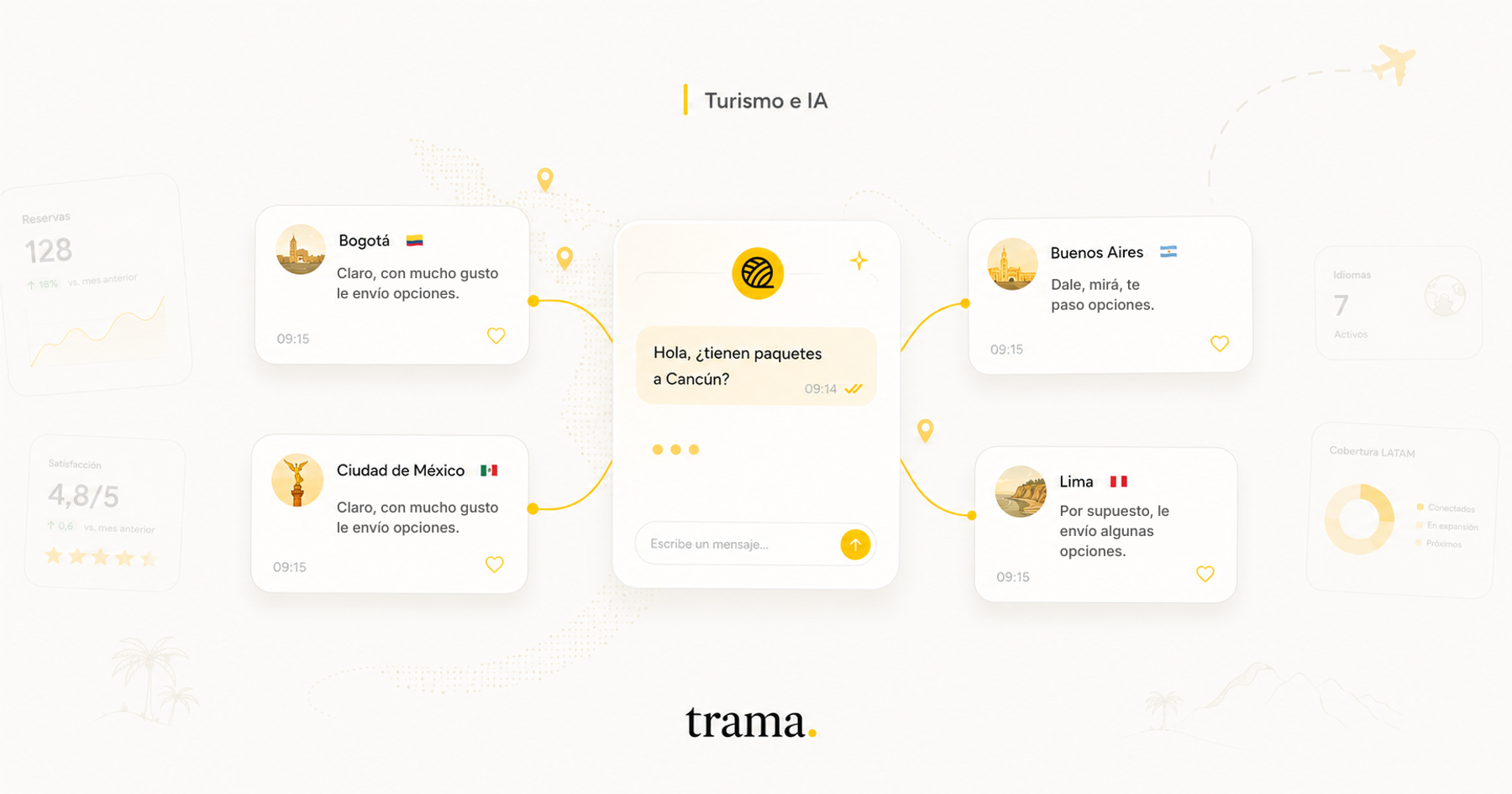
The agent handles travelers. Those travelers write from Bogotá, from Lima, from Mexico City, from Montevideo. All in Spanish. And there was the trap: since they all speak Spanish, the easy move was to have the agent answer in a single Spanish. The famous neutral Spanish.
We decided against it. And it's worth explaining why, because behind that decision is something that defines how we think about the whole product.
The same language isn't the same tongue
A Colombian traveler asking about a trip expects a certain warmth. A “with great pleasure,” an affectionate diminutive, a tone that feels attentive. An Argentine wants the opposite: get to the point, “got it, here you go,” no detours. A Mexican expects warmth and formality at once, a “of course” that makes them feel well taken care of. A Peruvian, something more measured and respectful.
The same inquiry, answered in exactly the same way for all four, connects with one and feels foreign to the other three. Not because it's badly written. Because it's written for no one. Neutral Spanish is a language no real person actually speaks. It's an average. And an average doesn't sit well with anyone, it simply doesn't offend anyone. In customer service, that isn't enough.
In travel, less than anywhere. The traveler isn't buying something off a shelf. They're about to trust someone with their vacation, their money, their days off for the year. The first impression matters, and the first impression is how you talk to them.
Why neutral Spanish was the easy way out
Let's be honest: neutral is comfortable. It's a single way to respond, a single one to maintain, a single one to review. Adapting the agent to each country is more work, more detail, more testing. It means getting into things a good AI model doesn't solve on its own, but rather understanding how people speak and what they expect in each place.
For years, software's answer to this problem was exactly that: the average. Put everything in neutral and move on. It was reasonable when adapting to each culture meant hiring copywriters in every country, maintaining a thousand versions, multiplying the cost. Neutral wasn't an aesthetic decision, it was an economic constraint disguised as an aesthetic decision.
The paradoxical part
Here's what interests us most about all this. AI gets accused of homogenizing, of flattening everything, of pushing us all into the same generic mold. And yet, used well, it allows exactly the opposite.
The constraint that forced neutral no longer exists. Today a single agent can talk to a Colombian the way a Colombian would, and to an Argentine the way an Argentine would, without multiplying the cost or the team. The tool many see as a cultural flattener is, used well, what lets us be more specific, more personal, more human with each person. Not less.
It's paradoxical, but it makes perfect sense: what seemed to condemn us to the average is exactly what frees us from it.
What this says about how we think about Trama
This decision, which started as a copywriting detail, ended up being a statement of principles. In travel, technology isn't enough. You can have the best model in the world, but if you don't understand the cultures, the people, and what happens in each reality, you're building a tool that's deaf.
That's why what for others is a config checkbox (“language: Spanish”) is for us a part of the product worth putting hours into. Even on a Saturday. Because the day a traveler in Bogotá feels that on the other end there's someone who talks to them the way a fellow Colombian would, we stop competing with a chatbot and start resembling what travel always was: a conversation between people who understand each other.
The same language isn't the same tongue. And now that we can finally honor that difference without it costing us a whole team, there's no reason to go back to the average.

Yaco Peralta
Co-founder & CEO, trama.
Construyendo trama. para que las agencias de viajes vuelvan a tener foco en la asesoría humana.
More posts by Yaco Peralta