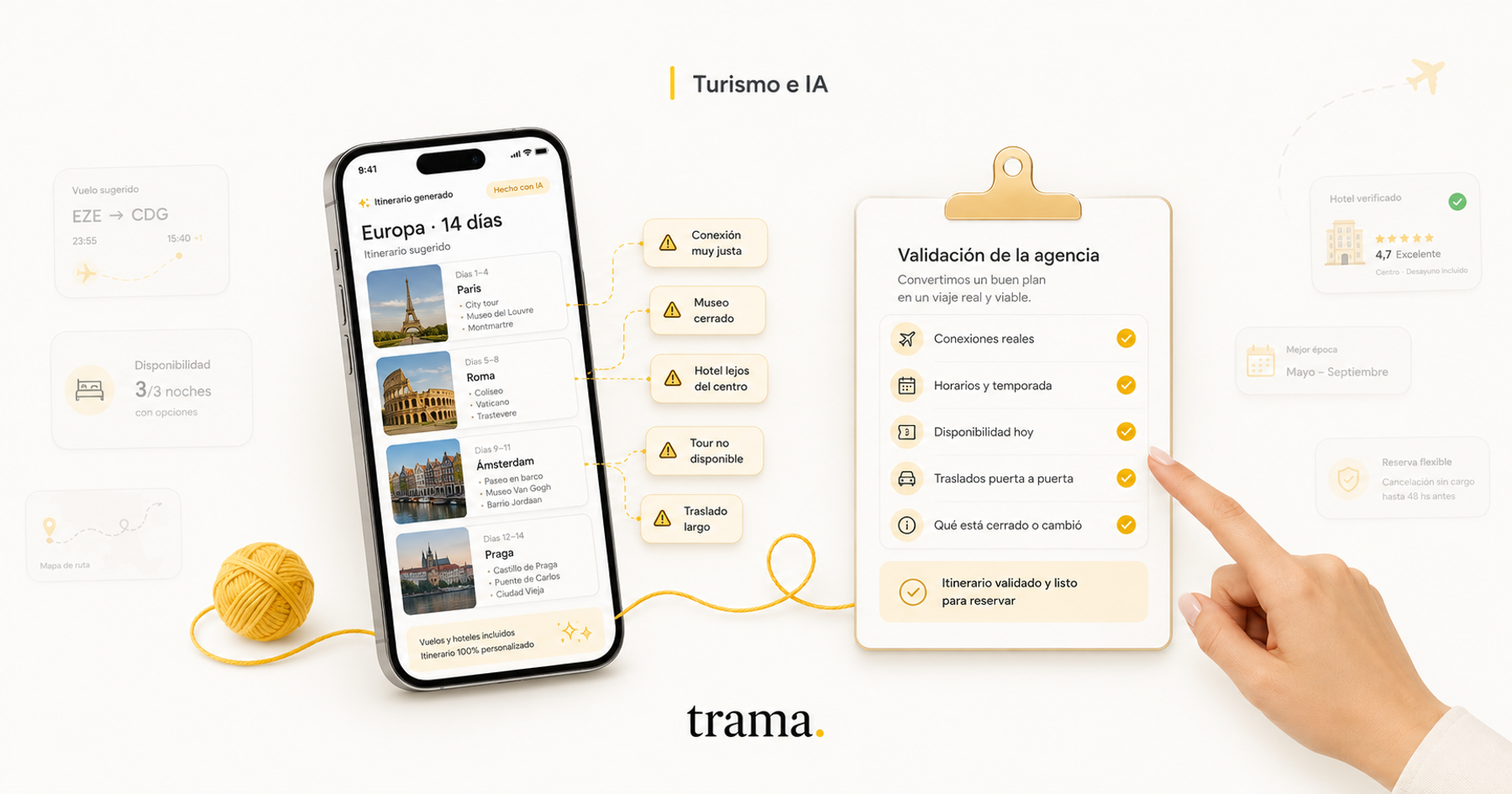
A client walks in with the whole trip already figured out. Fourteen days across Europe, day by day, hotels, times, all neat on their phone screen. An AI put it together in twenty minutes. And the seller's first reaction is almost always the same: to think this client does not need them anymore.
It is exactly the opposite.
The plan looks professional. Underneath, it is a minefield
More and more of them arrive this way. Not with an open question, but with a closed plan. A PDF, a screenshot, an itinerary that looks professional. And under all that polish, there is almost always a trap. A forty-minute layover in an airport where clearing the terminal takes two hours. A train that leaves before the flight lands. A well-rated hotel on the wrong side of the city from everything the client wants to see. A museum booked for the one day it is closed. Sometimes the place does not even exist anymore: a restaurant that shut down, a tour no one runs.
The seller feels two things at once, and both sting. That the client seems to need them less than before. And that the pretty plan is a minefield someone will have to defuse.
AI inspires. Operating is another job
It helps to understand why this happens, because it is not that AI fails. AI is very good at one thing: pulling scattered information together and handing back a proposal that sounds right. It inspires. It organizes ideas. It gives you a starting point in minutes. No one does that part better.
The problem is somewhere else. An itinerary is not won on what sounds good, it is won on what can actually be booked today. And that is where AI stops. It does not know the airport switched terminals, that in the rainy season the transfer takes three times as long, that the hotel is under renovation, that the entry requirement changed last month. It has no idea what is available this week or at what price. Inspiring and operating are two different jobs. AI does the first. The second is still yours.
What the agencies pulling ahead actually do
The ones getting ahead do not fight the traveler who arrives with a finished plan. They use it as a starting point. Three or four concrete things you can start this week, without installing or hiring anything.
First, change your opening question. Instead of asking how you can help, ask for the itinerary they already have. Send me what you put together and we will go through it. That saves you twenty minutes of discovery and moves you into a better position: you are not starting from scratch, you are the one who validates. The client already did half the work. Use it.
Second, build a five-point validation checklist and run it every time. Real connections with time to spare. Opening hours and season for each stop. Availability today, not last year. Door-to-door transfer times. And what is closed, under renovation, or simply gone. In ten minutes you turn a pretty itinerary into one that can be booked. That conversion is your product.
Third, reposition what you charge for. You are not charging to build the trip, a machine does that for free now. You are charging to make it viable, and to be on the other end when something falls apart on a Sunday at eleven at night in another time zone. AI does not do that. Once the client sees that difference, price stops being the conversation.
Fourth, get your own operation in order so you do not lose this traveler. The one who arrives with a finished plan is the furthest along in their decision, the closest to buying, and often the one we serve worst, because we treat them like any other inquiry. This is where AI can work on your side, but from the inside: sorting the inquiries that come in, keeping each client's context, and handing the seller the itinerary and the history already organized so the conversation starts where it matters. That is what we do with Trama, and there are other ways to get there. The point underneath is the same: no good inquiry slips away because things were a mess.
Fifth, save every itinerary you fix. Every error you catch is material you can sell with. Most of the AI-made plans we see have at least one connection that does not work. Said with your own numbers, that line beats any brochure.
Say that out of two hundred inquiries a month, thirty now reach you with an AI itinerary in hand. If you treat that group like they know nothing, or worse, make them feel their plan is useless, you lose them. And you lose the hottest traveler you had, the one who already decided to travel and is only looking for who can make it happen. At an average ticket, that is several sales a month walking out the door. Not because you could not sell, but because you did not see where your job began.
AI gave your client the map. You know which streets are closed. If you still see the person who walks in with the trip already solved as a threat instead of the hottest traveler of the week, that is the first thing to change. The rest is craft, and that you already have.
The next time a client arrives with an AI-made trip, do not read it as a threat. Read it as intent. They already imagined the trip. They already spent time on it. They are closer to buying than most people who write in. Your job does not start before AI, it starts after it: when someone has to separate what is possible from what merely looks good, organize the inquiry, and turn an idea into a real trip.
That is where the agency still matters. Not by competing with a tool that builds drafts, but by making the trip work once it stops being text on a screen.
Frequently asked questions
Are AI travel itineraries reliable?
They are useful as a starting point, but they should not be treated as a trip ready to book. They can include mistakes in timing, connections, availability, distances, or outdated places.
What should a travel agency do when a client arrives with an AI-made trip?
Ask for the itinerary, review it with a validation checklist, and show which parts are viable, which parts carry risk, and what should be adjusted before booking.
Does AI reduce the value of a travel seller?
Not necessarily. It changes where the value sits. The seller is no longer only the person who builds a proposal from zero, but the person who validates, corrects, organizes, and supports a decision that has already started.
Where can AI help inside a travel agency?
It can help organize inquiries, keep context, identify which client is further along, and give the seller a clear view of what has already been discussed. The final decision still stays human.

Yaco Peralta
Co-founder & CEO, trama.
Construyendo trama. para que las agencias de viajes vuelvan a tener foco en la asesoría humana.
More posts by Yaco Peralta