July brought four new models, a new working mode in ChatGPT, a voice that stopped taking turns and a name change. Here is what launched, and what you can do with the parts that matter.
What launched
GPT-5.6. OpenAI released its new family on July 9 with three versions: Sol, Terra and Luna. Sol is the most powerful, Terra the balanced one and Luna the fast and cheap one. It also adds a control to adjust how much the model thinks before answering.
Claude Sonnet 5. Anthropic released it on June 30 as its everyday model, handling long tasks better and at a lower cost than the previous generation.
Claude Opus 5. Released on July 24. It performs close to Anthropic's most expensive model at around half the price. It includes a fast mode running at about two and a half times normal speed, at twice the base price.
Gemini 3.6 Flash. Google made it the default model on July 21. Faster and cheaper than the previous one, with the same quality of answer for everyday use.
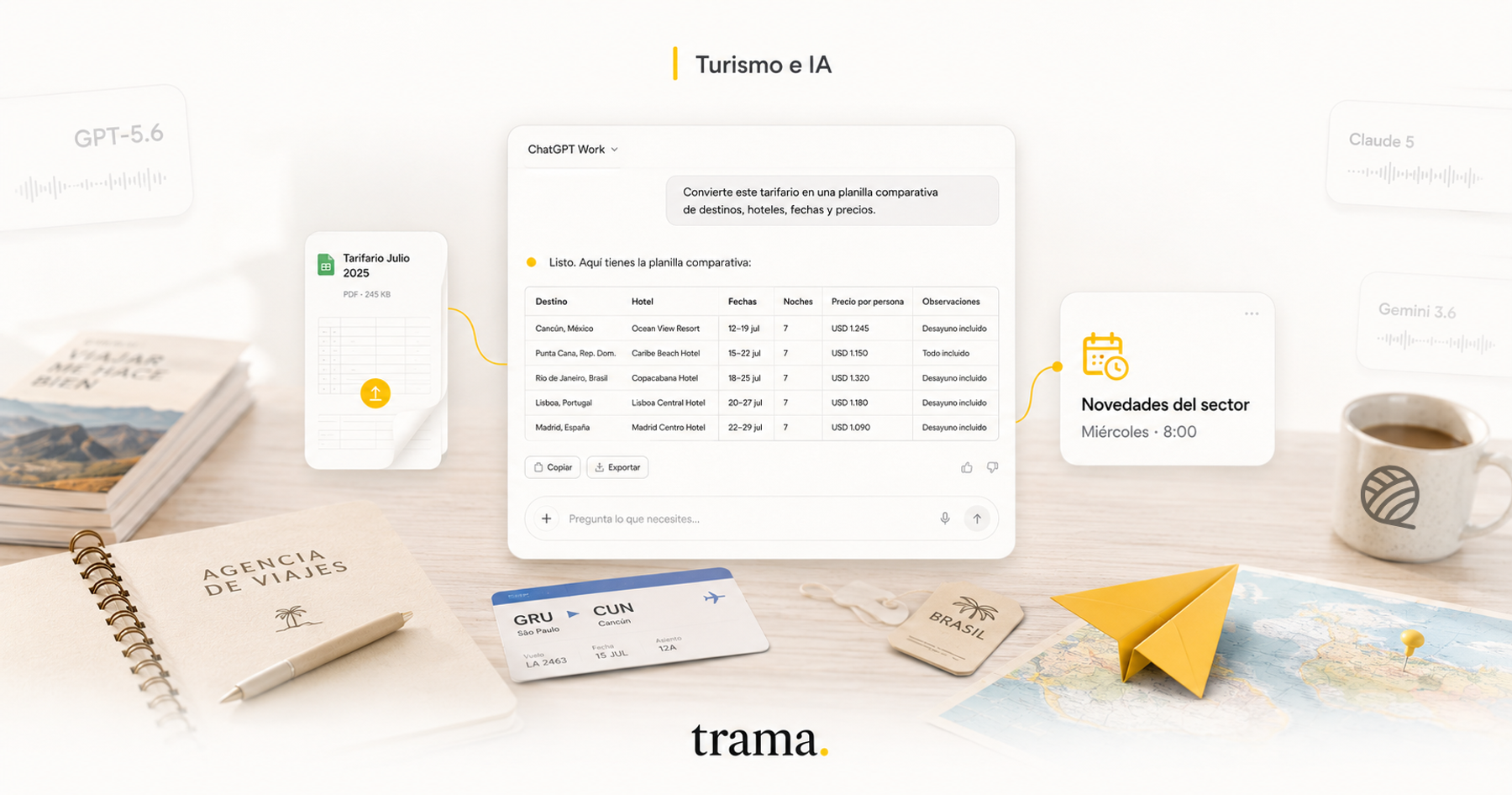
ChatGPT Work. Since July 10. A new mode inside ChatGPT that hands you the finished work instead of answering you.
GPT-Live. In July, ChatGPT's voice stopped working in turns. It now listens and speaks at the same time, tolerates being interrupted, and translates on the fly instead of waiting for you to finish the sentence. If you handle foreign travelers, that real time translation is the part that helps you.
Scheduled tasks. ChatGPT relaunched them on June 17 with a dedicated section in the sidebar. In Claude they live inside Cowork.
Gemini Notebook. On July 16 NotebookLM was renamed. The name changed and nothing else: same notebooks, same address, same files.
The new models are better in general, but for drafting a proposal or summarising an enquiry they all perform about the same, and versions get renewed every couple of months. Where there is something concrete to do this month is in scheduled tasks and in Work.
Scheduled tasks
You describe a task once, in plain language, choose how often it runs, and it runs on its own. Nothing to open, no conversation to leave running. In ChatGPT they are listed in the Scheduled section of the sidebar, with the time for each one, and from there you pause, edit or delete them.
One example, written exactly as you would paste it: "Every Wednesday at 8, search for last week's news about the airlines operating in Argentina, route changes, and promotions from wholesale operators to Brazil, the Caribbean and Europe. Ten lines maximum, only what affects a retail agency, and cite the source for each point."
Wednesday at 8 the answer shows up as a new message. Nobody had to remember to look anything up.
In ChatGPT they are available on paid plans, and the number of active tasks depends on which one you have: 3 on Go, 5 on Plus, 10 on Business and Edu, 15 on Pro and Enterprise. They are not on the Free plan. Two limits worth knowing before you build anything: a task cannot run more than once per hour, and if you delete the chat where you created it, the task pauses itself.
In Claude they sit inside Cowork, for the Pro, Max, Team and Enterprise plans. They are rolling out in stages and started with Max, so you may not see them yet. They run in the cloud, which means they execute with your computer switched off.
Five that work in an agency:
Exchange rate. Every day at nine, and only alert me if it moved more than two percent.
Industry news. Wednesdays, what happened with the airlines operating in the country, route changes and wholesaler promotions. Ten lines, only what affects a retail agency.
Entry requirements. Mondays and Thursdays, whether visa or vaccination rules changed for the destinations you sell most, with the official source for each change.
Content for the week. Sunday night, five posts for the week, with the season and the local holidays already accounted for.
Inbox summary. If you have your mailbox connected, every morning what came in, what needs a reply and what can wait.
What these tasks cannot do is get into your operation. ChatGPT does not know what you quoted, to whom or for how much, so there is no way to schedule the follow up on quotes that got no reply, or the Friday commercial wrap up, or the alert on deposits about to expire. For that the assistant needs the agency's data and needs to live where the work happens. In Trama the advisor asks for it right there: they write "remind me to contact the Gomez family next month" and the reminder comes back through the same chat.
ChatGPT Work
It is not a model or a separate app. It is a different mode inside ChatGPT, selected from the menu at the top left. Regular chat answers you. Work takes a goal, breaks it into steps, works for a long stretch and hands back the finished deliverable: a spreadsheet, a presentation, a report.
While it works you can see what it is doing. It asks when something is unclear, you can change direction midway, and it requests approval for anything important before executing it. It feels less like using a search engine and more like delegating something to someone who then shows you the result.
Work operates on the files you give it. In an agency it is useful for building the three option comparison for the same destination in a spreadsheet, for cross checking the file the operator sent you against your payments sheet, or for turning a forty page rate sheet into an ordered table. It is for the tasks that take you an hour and a half today, not for answering a single enquiry.
It launched first on the Pro, Enterprise and Edu plans, and later reached Plus and Business. It is not on Free or Go. Claude has an equivalent mode called Cowork, so when someone says "I do that with Work", it is worth asking which one they mean.
Work performs better the more things it has connected, and that is where an acronym you will see more and more comes in: MCP. It is a standard plug between an AI tool and a source of information. Before, you had to copy and paste the data by hand every time you asked something about your business. With this the tool connects on its own. Trama has one, so you can connect it to ChatGPT or Claude and ask about what is happening in your agency without leaving there.
Where to be careful
ChatGPT, Claude and Gemini do not book or issue tickets, and they do not connect to your system on their own. They get things wrong exactly where it costs most: prices, availability, flight times and entry requirements. If you schedule the task that checks visa changes, it is useful for finding out, never for confirming anything to a traveler. That gets checked against the official source before you tell anyone anything.
And anything coming out of a scheduled task is worth reading before you forward it. The task runs with nobody supervising it, and that is its value and its risk at the same time.
To get started one scheduled task is enough. The industry news one gives time back the fastest, because it replaces the stretch that goes into checking newsletters and WhatsApp groups. Once that becomes a habit, add the second.

Yaco Peralta
Co-founder & CEO, trama.
Construyendo trama. para que las agencias de viajes vuelvan a tener foco en la asesoría humana.
More posts by Yaco Peralta