There is a habit I kept seeing, and it stayed with me. An agency owner asks Trama how the month is going, reads the answer, copies it, opens another tab and pastes it into ChatGPT to put together the promotion for the week.
That copy and paste is the seam that was still open. On one side, an assistant that handled every inquiry, worked out what trip each person was looking for, asked the questions that were missing, routed the lead to the right salesperson and followed the process through to the close. On the other, the artificial intelligence where she writes, thinks and solves everything else. Two tools working for the same agency, not talking to each other.
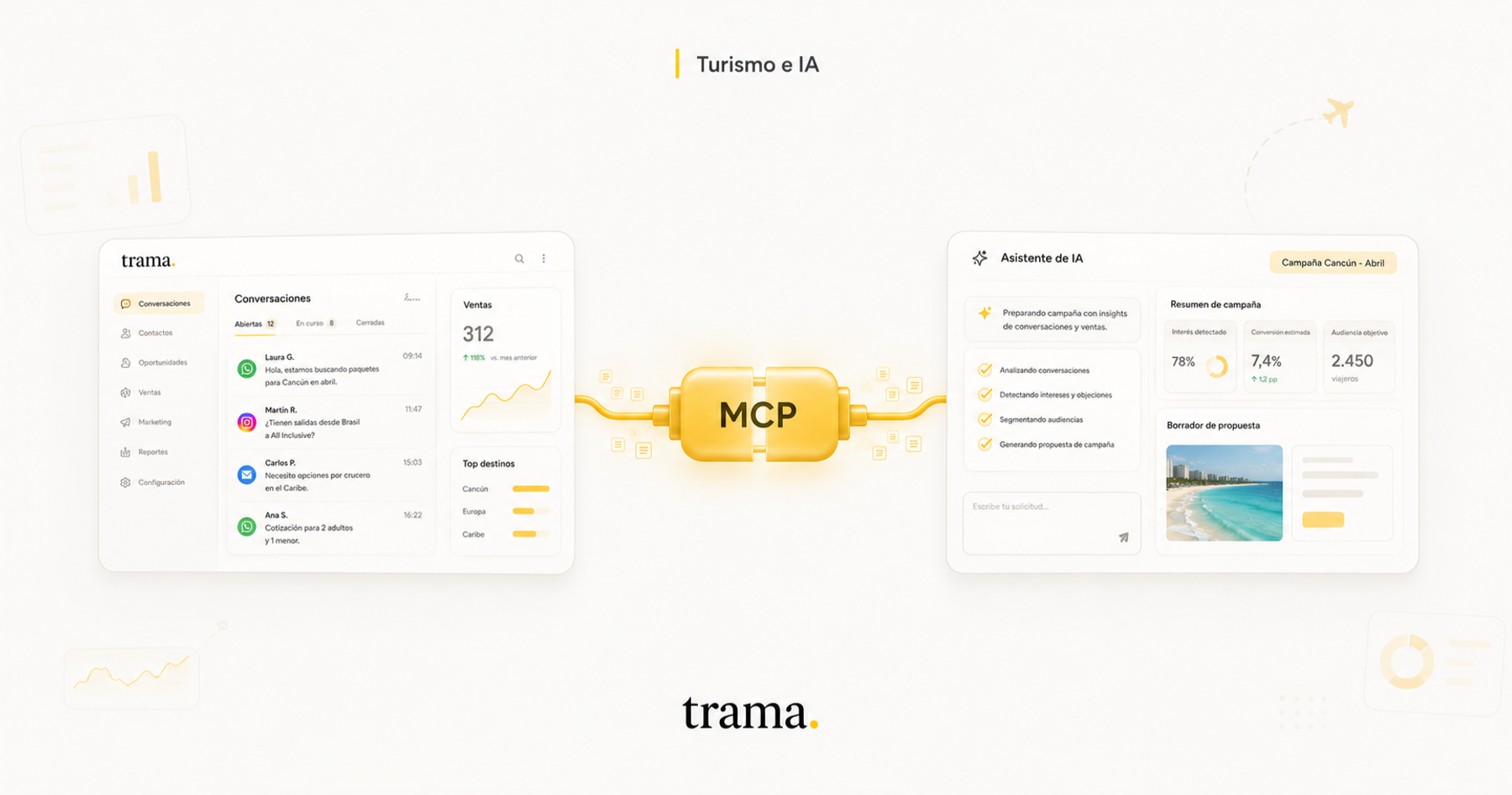
MCP is what connects them.
What MCP is, plainly
MCP stands for Model Context Protocol. It is an open standard that appeared in late 2024 and, in a little over a year, became the usual way to connect artificial intelligence assistants to real systems.
The idea is simple. Before, for an AI to work with what happens inside a system, someone had to program a custom connection for every combination of assistant and system. MCP defines a common language: the system publishes once what information it can hand over and what actions it can run, and any assistant that speaks that language understands it. It is the universal plug of this stage.
In an agency that translates into something concrete. The assistant that knows and runs your commercial process can work inside ChatGPT, inside Claude, inside whatever assistant your team uses, or inside one you build yourself.
What changes when it moves into your AI
The first thing is that the tab in the middle disappears. You ask how the month is going and you write the promotion in the same place, with the answer already there. It is the smallest of the three improvements and the one you notice on day one.
The second is more interesting. Trama knows everything that happened on the commercial side, because it was there. It does not know how much you spent on ads this month, or what the wholesaler emailed you, or how cash is doing, or what is on your calendar next week. Your AI can have access to that. Only with both halves together can you ask questions that had nowhere to stand before.
How much each sale actually cost, counting real ad spend and not what the ads platform reports. Whether the supplier who takes longest to confirm is the same one costing you quotes. Whether the weeks you sell least are exactly the ones with a calendar full of meetings. No single system answers those, because each piece of the answer lives somewhere else.
The third is the one I find most exciting and the hardest to see at first. With MCP, the assistant stops being only something you talk to and becomes a capability other assistants can use as a tool. The one that builds your monthly report goes and gets the commercial data on its own. The one that prepares campaigns checks what demand came in before suggesting who to write to. You stop sitting in the middle, moving information from one window to another.
Why the answers are worth having
There is one detail that explains why this works better than it sounds. The information behind the answers does not come from a database somebody filled in later, when they remembered. It comes from whoever was in every conversation: asked, understood what the traveler wanted, qualified and routed.
A well-ordered file gives you back what you put in. Whoever ran the process can tell you why that quote went cold.
That difference is what travels when the assistant moves into your AI. What arrives is not columns for you to interpret. It is judgment about what already happened.
Five questions worth asking it
- 1
How is the agency doing today
Important inquiries that came in, which ones are waiting on a reply, which quotes need follow-up and where sales are at risk. And then, in the same conversation, ask it to prioritize what is urgent, reassign whatever went unattended and set up the follow-up on every opportunity.
- 2
Which campaign brought sales and which brought noise
The commercial side has which inquiries each campaign generated and how they ended. The ads side has what each one cost. Together they give you real cost per sale, not the cost per inquiry the ads dashboard shows.
- 3
Why are we selling less
Are fewer inquiries coming in, are they coming in worse qualified, or is the team not following up? Three different problems with three different fixes, and confusing them costs months. With ad data alongside, the split gets cleaner: if inquiries dropped, the problem sits before your team; if they held steady and sales fell, it is inside.
- 4
Which past travelers would want this new departure
The history and intent of everyone who ever wrote in, crossed with the departure calendar and the dates the operator confirmed by email. Instead of a list of names, the messages drafted for you to review before sending.
- 5
Which salesperson needs help, and where
It is not who sells least, it is which step they get stuck at: first reply, quote, follow-up or close. If it can also see the team calendar, you can tell the one who is overloaded from the one who needs training. Two very different conversations.
What it does not do
Worth saying, because enthusiasm is running high here and expectations get disorderly fast.
It answers with the information that exists. If sales get closed off-system in your agency and nobody logs them, that gap stays. It does not decide for you: it organizes, cross-references, suggests and runs what you asked it to run. And it sees only what the connected account is allowed to see, with the same permissions that person has inside the system, which in an agency with several salespeople is not a minor detail.
It is also not for everyone at the same time. At thirty inquiries a month the operation fits in your head and this adds little. It starts to pay off when it no longer fits: several salespeople, several live campaigns, quotes going cold without anyone noticing.
What this says about software in the sector
For twenty years travel software was designed around the same idea: that you come in. To the panel, the report, the dashboard. Competing in this sector meant having the most complete screen.
That is ending. What will set a tool apart from here on is how well it works outside its own screen, with you and with any other assistant working for your agency. A system that only knows how to show itself inside its own app, however good looking, gets left out of that conversation.
If you want to measure it in your own agency, the test is short. Think of the three questions you ask yourself every Monday. Then check how many different tools hold pieces of the answer. If it is more than one, you are doing that cross-referencing by hand, every week.
What is MCP?
MCP stands for Model Context Protocol, an open standard that lets an artificial intelligence assistant connect to a system, request information from it and ask it to run actions, without programming a custom connection for every combination. It appeared in late 2024 and the main assistants on the market support it today.
Do I need to know how to code to connect it?
No. You connect it once from your assistant's settings, and from then on you use it by writing in plain language, the same way you would write to someone on your team.
Can it only read information, or also make changes?
Both. It can read the state of the agency and also move opportunities, reassign owners, leave reminders and prepare follow-ups, always with the permissions of the account it is connected from.
Which assistants can use it?
ChatGPT, Claude and any assistant that supports the standard. That is the advantage of an open protocol over a closed integration with a single tool.
Is it safe to connect my agency's system to an AI?
The connected assistant sees exactly what the person whose account was used to connect it sees, not one field more. If it is a salesperson's account, it sees their book; if it is the owner's, it sees the whole agency. And every action is logged just as it would be if they had done it by hand.
What information can it look at?
Inquiries, traveler intent, customer history, opportunities, quotes, commercial activity, owners and catalog.
Is it worth it for a small agency?
Less than you would think. At thirty inquiries a month the operation fits in your head. It starts to pay off when you have several salespeople, several live campaigns and quotes going cold without anyone noticing.

Atahualpa Herrera
Co-founder & CTO, trama.
A cargo del producto y la tecnología de trama. Convencido de que una buena herramienta se siente como un compañero de equipo, no como una pantalla más para llenar.
More posts by Atahualpa Herrera