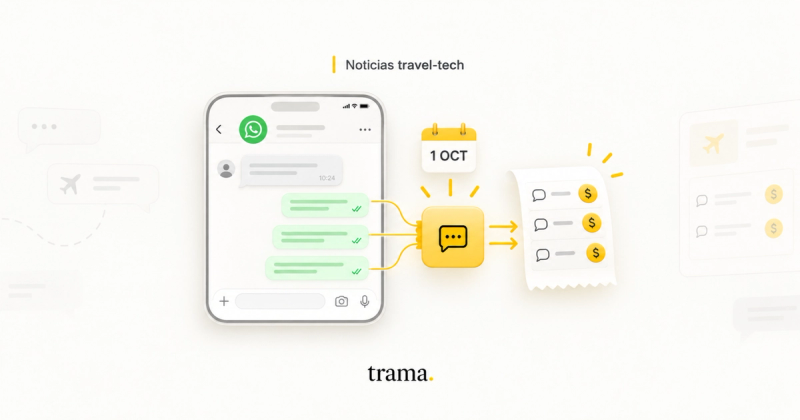
On 1 October Meta starts charging for every reply that goes out through the WhatsApp API. That put a price on a decision most agencies made without looking at it: whether the whole team answers from one number, or every salesperson has their own.
The bill is the easy part to explain. The part that matters comes after.
The two ways to run WhatsApp in an agency
The first one is what almost every tool sells. A company number, a web inbox, the whole team inside it. An enquiry comes in, lands in a list, somebody picks it up. It is tidy, everything is visible from one place, and it can be set up in an afternoon.
The second one existed before the software did: every salesperson answers from their own WhatsApp, the one on their phone, the one their customers already have saved.
Most of the market pushes the first way. We chose the second, and it is worth explaining why before it looks like a limitation.
What shows up on the bill
Meta gives away the first 1,000 messages of each month, and it counts them per phone number, not per company. A team of three answering from a single number has 1,000 free messages. That same team, with a number each, has 3,000.
There is a second effect, and it is bigger than the first: whatever the salesperson types by hand from the WhatsApp Business app is never charged, even with their number connected. Meta says so plainly in its documentation. On a shared number that cannot happen, because the number is in nobody's pocket: everything goes out through the API and everything counts.
If you want to see the difference with your own numbers, we built a calculator with the official rates for the 47 markets Meta lists.
What does not show up on the bill
This is the real reason, and it has nothing to do with money.
On a shared number, the customer is not writing to anyone. They are writing to a company. The conversation is with a logo, and continuity depends on the tool remembering who handled them last time.
With the salesperson's number, the customer writes to a person. And when they come back, they come back on their own. They do not land in a queue for somebody to hand out: they land in the chat they already have open, with the same name at the top.
In travel that is not a detail. Repeat business is slow, personal and built on trust: somebody who travelled well writes again eight months later, through the same place they wrote the first time. If that place is the agency number, the conversation starts from scratch.
And attribution stops being a question
A shared inbox knows who replied too. What it cannot do is make the enquiry arrive with an owner: somebody has to assign it, by rotation, by rules or by hand, and that assignment is a decision that has to be made every day.
When every salesperson has their own line, the question never comes up. The enquiry reaches the person who is going to work it, and whatever gets measured per person afterwards does not come out of a routing rule: it comes out of what actually happened.
The objection, which is a good one
If the number belongs to the salesperson and the salesperson leaves, they take the customers with them. That is true, and it is the best argument against this.
So it helps to separate two things that get mixed up. One is where the line lives, which can be the salesperson's phone. The other is who owns the line, which can still be the agency. You can have both: a company number, on the phone of the person doing the talking.
And either way the whole conversation stays on the agency's side. Who wrote what, when, what was quoted and how it ended all live in the CRM, not on the phone. What the salesperson takes with them if they leave is their address book, which is exactly what they took before any software existed.
How we do it
The Trama agent answers on each salesperson's WhatsApp. It replies straight away, asks the questions that are missing, and hands the enquiry over only when it is worth someone's time. Meanwhile the salesperson can write from their phone the way they always did, and Meta does not charge for those messages.
This is not an aesthetic preference. It is that the enquiry arrives with an owner, the customer comes back to a person, and half the month's messages never reach the bill.
Rates are set by Meta and can change every quarter. The calculator shows the date we checked each figure against the official documentation, and links the source.

Atahualpa Herrera
Co-founder & CTO, trama.
A cargo del producto y la tecnología de trama. Convencido de que una buena herramienta se siente como un compañero de equipo, no como una pantalla más para llenar.
More posts by Atahualpa Herrera