How to close more sales at your travel agency after the quote
A travel sale is rarely lost at the inquiry: it's lost after the quote. Six habits to ask for the deposit, follow up the quote and answer when the client hesitates, with messages for tomorrow.

Won (51) and lost (40) sales from 12 travel agencies that use Trama, June to October 2026, counted on 27-Oct-2026.
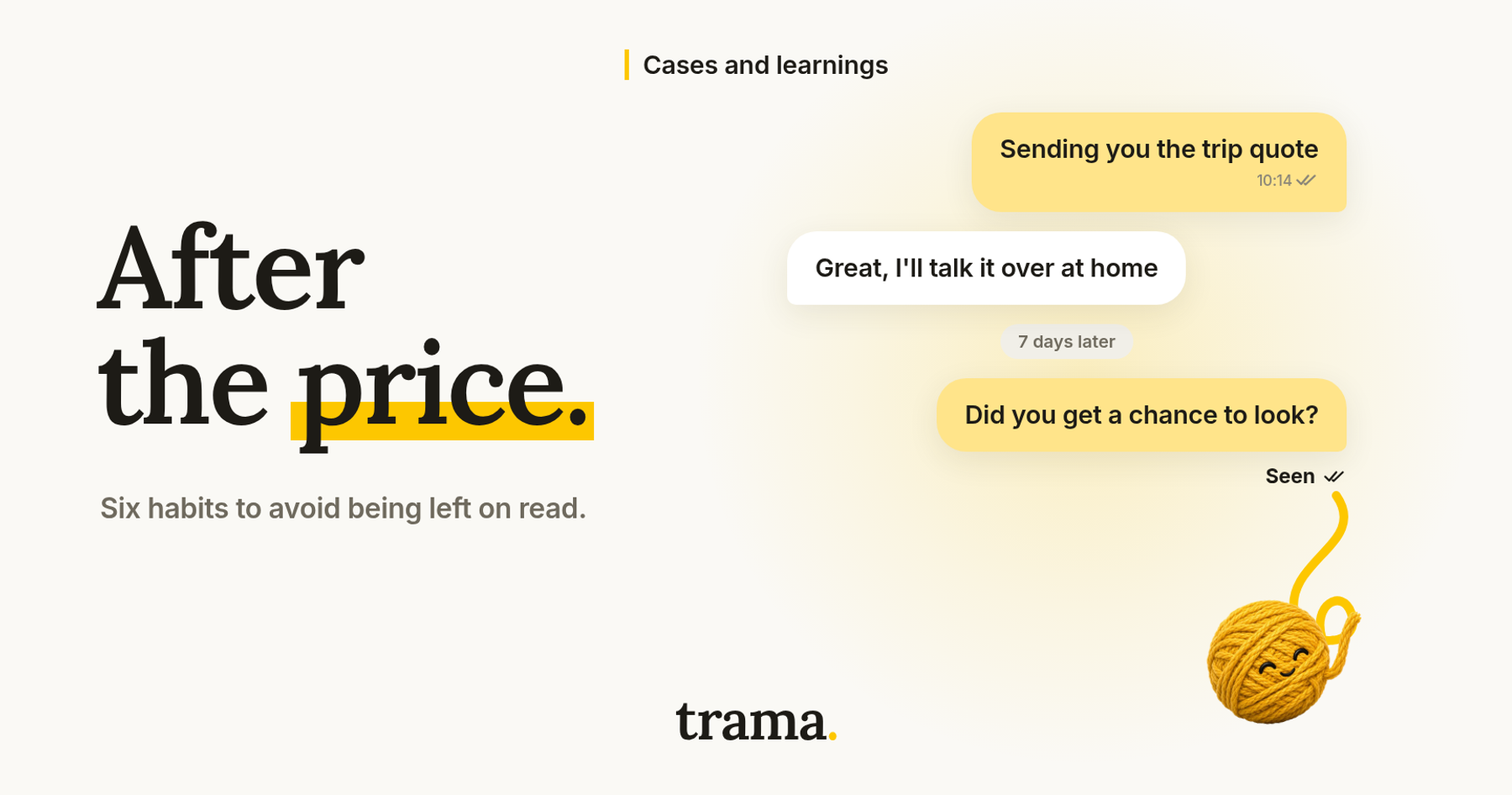
You sent the quote. The client replied "great, I'll talk it over at home" and the conversation stopped there. A week later you write "did you get a chance to look at it?" and get nothing back. If that sounds familiar, it isn't bad luck: it's where most of a travel agency's sales are lost.
A lot has been written about sales closing techniques, most of it for selling software or insurance. At a travel agency the sale is decided on WhatsApp, with a price that changes every day and a client who asks three agencies at once.
The result is decided after the price is sent, more than in the inquiry or in how fast it was answered.
How to close a travel sale after the quote
- 1
Ask for the deposit with a concrete step
Say how much it is, what it's for (it freezes the fare and secures the spot) and how to pay it.
- 2
Follow up with a question
Swap "did you get a chance to look?" for an easy question: "was it the budget, the hotel or the dates?".
- 3
Send the first follow-up the next day
Then three days later and a week later, each time with something new. At least three touches before marking the inquiry as lost.
- 4
Send two options with the total in the message
Explain what each one includes, say whether the price is per person or for the group, and say which one you'd pick.
- 5
Answer every objection with a concrete step
Hold the fare until a set time, ask to see the competitor's quote or offer a video call.
- 6
Ask about the budget before quoting
One question saves you from sending a proposal the client can't afford.
The sale is decided after the price
Answering fast and quoting well are the floor: without them there is no sale. What comes next is what usually decides whether it closes: whether the deposit was asked for, how the follow-up was done, and what the seller said when the client hesitated. There are six habits, and none of them needs a new tool.
1. Always ask for the deposit, and explain what it's for
Ask for the deposit with a concrete step: how much it is, what it's for and how to pay it. If you don't ask, the decision is left hanging and it's much harder to pick it back up.
What repeats the most is how it's framed. The deposit isn't a charge: it's what protects the client. It freezes a fare that moves every day, secures a seat on a flight or a room in a hotel with limited availability, or holds a promotion that's about to expire. Put that way, asking for it stops sounding like pressure.
To freeze this fare we ask for a 30% deposit, and you pay the rest month by month up to 30 days before the trip. If you want to go ahead, send me a photo of your IDs and I'll book it today.
What doesn't work is leaving the decision hanging. "Let me know if you need anything" hands the client the job of taking the next step, and they almost never take it.
2. Following up a quote: a question, not a reminder
A "did you get a chance to look at the quote?" gets a "yes" or no answer at all. The follow-up that works brings something: an easy question, a new option or a fact that changes the decision.
Before I keep searching: was it the budget, the hotel or the dates?
That question works because it gives the client an easy way to say what didn't fit, and it gives you somewhere to go next: another date, another hotel, another way to pay. For the rest of your messages, this guide covers how to write a follow-up that doesn't sound like a complaint and when you need a template approved by Meta.
3. When to send the first follow-up: the next day
Send the first follow-up the day after the quote, while the proposal is still fresh. If almost a week goes by, many clients have already decided, and not with you.
A rhythm that works: the day after you send the proposal, three days later and a week later, each time with something new. And before you mark an inquiry as lost, at least three touches. Many are closed as "no response" after a single follow-up message.
4. How to present the quote: two options, the total and which one you'd pick
Send two or three options, explained in the chat itself: what each one includes, the total price and which one you'd pick and why. The PDF is the backup; it doesn't replace the explanation.
I put together two options for the four of you. The one I recommend is USD 3,900 in total, with flights, transfers and all-inclusive. The other one costs less, but the hotel is further from the beach.
A small mistake that costs a lot: not saying whether the price is per person or for the whole group. The client does the math the scary way and doesn't ask again.
5. How to answer the most common objections
When the client hesitates, the difference is in your answer. "Sure, I'll be here" leaves the sale in their hands; a concrete step keeps it in yours. These are the three objections that come up the most, and a concrete way to answer them.
"I'll talk it over with my partner". Hold the fare until a set time and offer a call with both of them.
Sure, take your time. I'll hold it for you, no commitment, until 6 pm tomorrow, and if you like we can go over it together on a video call.
"I found it cheaper". Don't drop the price blindly. Ask to see the other quote and compare the airline, the hotel and the transfers. If something needs adjusting, you adjust the product, not the margin.
Send me that quote and I'll compare it. If it's the same, I'll match it; if it isn't, I'll show you the difference.
"I don't know you". Distrust goes away when you make yourself visible: a video call, the office address, your license number, your reviews. A call, a video call or a visit often unblocks what a message can't.
6. One question before you quote
Quoting without knowing how much the client wants to spend is a gamble. If the first proposal is far from what the person can pay, the price objection shows up late and it's harder to rework. One question is enough.
So I can put together something that fits: how much are you thinking of spending in total, and what matters most to you, the hotel, the dates or the price?
How to know it's working
Three numbers are enough to see whether the team is closing better, without waiting for the end of the month.
Deposit asked. Of the quoted inquiries, in how many the seller asked for the booking with a concrete step. The goal is all of them.
First follow-up. How long it takes between the quote and the first follow-up message, counted in office hours. One business day is the target.
Follow-ups answered. Of the follow-up messages, how many got a reply from the client. If it's few, the problem is usually the message, not the client.
If your team sells from their own WhatsApp, with Trama's seller WhatsApp every conversation stays with the agency. In My Day, each seller sees which quotes are waiting for a follow-up, with a suggested message they review, edit and send themselves. The follow-up and the close are always done by the seller: Trama keeps the work organized, it doesn't sell for you. And if you want to organize the whole path from inquiry to quote, start with how to sell more trips on WhatsApp.
Frequently asked questions
How do I close a travel sale on WhatsApp?
With a concrete step after the quote: ask for the deposit explaining that it freezes the fare and secures the spot, say how to pay it and ask for the details to book. The first follow-up, the next day, keeps the proposal moving.
What should I say to a client after sending a quote?
An easy question, not a "did you get a chance to look?", which gets a yes or silence. "Was it the budget, the hotel or the dates?" gives them an easy way to tell you what didn't fit. And if they showed interest, the next step: how much the deposit is and how to pay it.
How much deposit should I ask for on a travel package?
There isn't a single percentage. What's usual is to agree on a deposit that freezes the fare and secures the spot, and the balance in installments or month by month up to 15 to 30 days before the trip. More important than the percentage is explaining what it's for.
How many follow-ups before marking an inquiry as lost?
At least three: the day after the quote, three days later and a week later. Each one with something new: a concrete question, another option, a way to pay or availability news. Asking "did you get a chance to look?" three times doesn't count.
What do I do if the client says they found it cheaper?
Ask to see the other quote before lowering your price. Often the difference is the airline, the hotel or what's included. If it's the same, match it; if it isn't, show the difference. There's no need to give a discount without comparing.

Yaco Peralta
Co-founder & CEO, trama.
Construyendo trama. para que las agencias de viajes vuelvan a tener foco en la asesoría humana.
More posts by Yaco Peralta