Foreign arrivals are up 15.3%: what it means for your travel agency
In September, 432,200 foreign tourists came to Argentina, 15.3% more than a year earlier, while 13.2% fewer Argentines traveled abroad. What INDEC's data says and how to prepare.

Figures checked against INDEC's technical report of October 26, 2026. trama. features checked against its public website and docs.
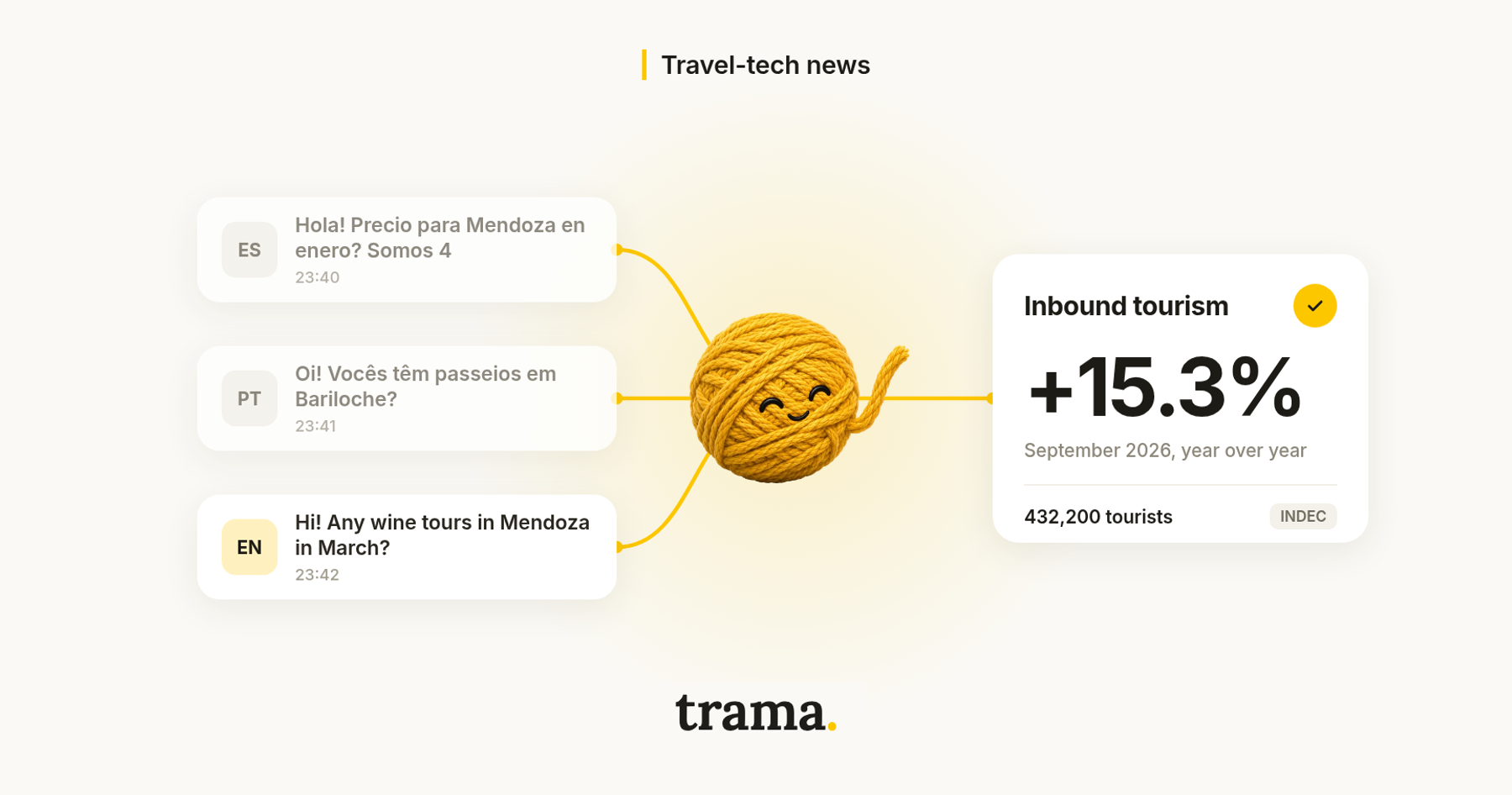
In September, 432,200 foreign tourists arrived in Argentina. That is 15.3% more than in September last year. In the same month, 613,100 Argentines traveled abroad, 13.2% fewer. INDEC, Argentina's national statistics institute, published the numbers on Monday, October 26, in its international tourism report.
That is two pieces of news in one. If you sell inbound travel, more people from abroad are writing to you. If you live off outbound, every inquiry that comes in is worth more than it was a year ago. Either way, the challenge is the same: don't let a single one slip away.
September by the numbers
- Arrivals. 432,200 non-resident tourists, 15.3% more than in September 2025. Add same-day visitors, who don't stay overnight, and it comes to 733,600 visitors, up 14.2%.
- Departures. 613,100 resident tourists traveled abroad, 13.2% fewer. Including same-day visitors, 1,047,700, down 13.0%.
- Balance. More people still leave than arrive: the gap was 180,800 tourists. Working it out from the changes in the report, our own calculation puts that gap at around 330,000 in September 2025.
Half of them fly in. 52.9% of foreign tourists arrived by air, 34.8% by land and 12.4% by river or sea. Air arrivals reached 228,500 tourists, 21.2% more than a year ago, and 88.3% of them came through Ezeiza or Aeroparque, Buenos Aires' two airports.
Where they come from
Brazil is still the top market, and it grew. These are the origins that moved the most, according to INDEC's table of tourists by country of residence:
- Brazil: 113,800 tourists, up 22.3%. That's 26.3% of everyone who arrived.
- Uruguay: 78,100, up 11.2%.
- Rest of the Americas: 59,800, up 25%.
- Europe: 42,400, up 13.8%.
- United States and Canada: 25,800, up 26.2%. The fastest-growing group in percentage terms, though still small in volume.
Where Argentines stopped going
The drop in outbound travel isn't even. It's concentrated in short trips to neighboring countries:
- Chile: 83,500 tourists, down 32.3%.
- Brazil: 124,000, down 20.1%. It's still the number one destination.
- Paraguay: 67,900, down 17.3%.
- Europe: 94,000, down 10%.
And some destinations held up: trips to the United States and Canada were practically flat (50,700, +0.3%), and trips to the Rest of the Americas rose 8.1% (88,800).
You can see the difference in how people travel, too. Departures by land fell 24.8%. Departures by air, 5.7%. The long-haul flight is holding up far better than the quick getaway by car or bus.
Month over month, things are steady
INDEC also publishes a seasonally adjusted series, which strips out the effect of the season so you can compare one month with the previous one. There the picture is calmer: air arrivals of foreign tourists grew 0.1% over August and the trend didn't move. Argentines leaving by air fell 1.4%, and the trend, 1.2%.
In plain terms: the jump against last year is big, but it isn't a wave that keeps growing every month. It's a higher level that is holding. For planning, that's better news than a spike.
Who the arriving tourist is
INDEC also surveys tourists entering and leaving through Ezeiza and Aeroparque. In September, among foreigners who arrived through those two airports:
- 60.5% came on vacation. 19.5% came to visit family or friends.
- They stayed 10.7 nights on average. Europeans, 19.5.
- 49% stayed in hotels and 26.6% rented a house or an apartment.
- What they did most was eat out (67.4%) and visit cultural venues (66.2%).
And across the whole third quarter, 609,400 foreign tourists came through Ezeiza and Aeroparque, 18.5% more than a year earlier. They spent USD 640.5 million, up 11.5%, with an average daily spend of USD 94.5 per person. The biggest daily spenders were Brazilians (USD 121.4) and visitors from the United States and Canada (USD 117.2). Total spending by that last group grew 54%.
What it means for your agency
The data tells you how many arrive and from where. What comes next you already know by heart if you work in tourism: more people from abroad means more inquiries that don't look like the usual ones.
They write in another language. Brazil is the top market and the United States and Canada are the fastest-growing. That means Portuguese and English. If the Portuguese inquiry gets answered by "whoever gets by a little" whenever they can, the reply arrives late and arrives badly.
They write from another time zone. Someone planning a trip from Toronto or Madrid writes when it suits them, not when you open. And someone writing from São Paulo, on your same clock, may do it after work, when you've already closed.
They ask different things. The visitor wants to know what to eat, what to see, how to get around, how many nights make sense. According to INDEC's survey, food and culture are what they do most. If you have that answer ready, you're halfway there.
And if you sell outbound, your margin for error is smaller. With 13.2% fewer Argentines traveling, every inquiry that comes in weighs more. You can't let one go cold over a weekend. Look closely at where demand is falling, too: land getaways to neighboring countries dropped far more than trips by air.
For some outbound agencies, this is also an opportunity. If you already work with local suppliers, a product for visitors (a food tour, a getaway from Buenos Aires, a well-run transfer) can make up for part of what isn't selling abroad today. It's not for everyone, but it's worth running the numbers.
How to get ready: five things to do this month
- Reply fast, even after hours. Whoever asks at night or on a Saturday is comparing. The first one to answer well, with real details, keeps the conversation.
- Be where they write to you. WhatsApp, Instagram, the chat on your website. Every channel you don't answer is a door you leave shut.
- Answer in their language. Prepare your frequent answers in Portuguese and English. And if someone on your team speaks the language, make sure inquiries in that language reach that person.
- Qualify before you quote. Dates, number of travelers, budget, where they're traveling from and what they want to do. With that you build a proposal that works, instead of sending a generic rate sheet.
- Follow up. An inquiry nobody touches for two days is an inquiry that went to someone else. Decide when you write again and who does it.
And a bonus sixth: check your numbers. Look at how many inquiries came in this month in another language or from another country, and how many turned into a sale. It's the best way to know whether the growth INDEC measures is already reaching you.
Where trama. comes in
We built trama. for exactly this part of the job. It's an AI employee that answers your WhatsApp, Instagram, Messenger and website chat, at any hour. It replies in Spanish, Portuguese or English depending on the language the customer writes in, and hands the inquiry to the rep who speaks that language.
While it chats, it gathers the trip details: destination, dates, travelers and budget. When the inquiry is ready, it hands it to someone on your team with all the context. Your team closes the sale: trama. doesn't replace your reps. And if an opportunity sits still, it reminds the rep to write again.
The CRM, the catalog and the Offer Link are free on every plan. What you hire is the AI employee. If you want to see how it would handle your agency's inquiries, start free at trama.so.
Frequently asked questions
How many foreign tourists arrived in Argentina in September 2026?
432,200 non-resident tourists, 15.3% more than in September 2025, according to INDEC. Including same-day visitors, who don't stay overnight, there were 733,600 visitors.
How many Argentines traveled abroad in September 2026?
613,100 resident tourists, 13.2% fewer than a year earlier. The steepest drops were in trips to Chile (-32.3%), Brazil (-20.1%) and Paraguay (-17.3%).
Which countries do tourists visiting Argentina come from?
In September, the top origin was Brazil, with 113,800 tourists (26.3% of the total), followed by Uruguay and the Rest of the Americas. The fastest-growing were the United States and Canada (+26.2%), the Rest of the Americas (+25%) and Brazil (+22.3%).
How much does a foreign tourist spend per day in Argentina?
In the third quarter of 2026, tourists who arrived through Ezeiza and Aeroparque spent an average of USD 94.5 per day. Brazilians spent USD 121.4, and visitors from the United States and Canada, USD 117.2.
Notes and sources
- INDEC, "Estadísticas de turismo internacional. Septiembre y tercer trimestre de 2026" (in Spanish), technical report, October 26, 2026. Arrivals and departures by route and country, seasonally adjusted series (tables 5 and 6), profile of tourists at Ezeiza and Aeroparque, and third-quarter spending (tables 18 and 19). The September 2025 gap is our own calculation from the published changes.
- INDEC, international tourism page (in Spanish). Methodology and release calendar.
- trama., "How the agent works". Channels and when it hands off to a rep.
- trama., "Tourism CRM in Argentina for travel agencies". Replies in Spanish, Portuguese or English and routing by language.
- trama., "Lead routing" and "Availability". How an inquiry is assigned based on the languages each rep speaks.
- trama., "Reminders". Alerts to the rep when an opportunity sits still.

Yaco Peralta
Co-founder & CEO, trama.
Construyendo trama. para que las agencias de viajes vuelvan a tener foco en la asesoría humana.
More posts by Yaco Peralta